Showing posts with label Unemployment. Show all posts

Monday, April 4, 2011

NCOA Launches One Away Campaign for Elder Economic Security; Releases National Poll on Struggles Facing Older Adults

Ken Schwartz, NCOA Director, Marketing & Communications, 202-600-3131, ken.schwartz@ncoa.org

Washington, D.C. (March 31, 2011) – More than 13 million older adults are considered economically insecure, living on just $21,780 a year or less. Every day, these seniors, and millions of Boomers, have to choose whether to pay for food, housing, utilities, or out-of-pocket for medication costs. They live one bad break, one accident, or one layoff away from economic disaster.

To spotlight their struggles—and call for change—the National Council on Aging (NCOA) is launching One Away, an innovative, national advocacy campaign that uses video to allow older adults to tell their own stories, in their own words. One Away videos and stories are available at OneAway.org.

“We are already receiving real stories of seniors who are struggling,” said Sandra Nathan, senior vice president for economic security at NCOA. “It’s clear that vulnerable older adults are in desperate need of help and want to be heard.”

National Poll Shows Depth of Problem

Almost two-thirds (63%) of adults aged 18+ said they or an older adult they know is struggling to make ends meet in today’s economy, according to the new One Away poll. A majority (62%) also knows that one out of three older adults relies on Social Security for over 90% of their income.

Commissioned by NCOA and conducted online in March 2011 by Harris Interactive, the One Away poll of 2,526 adults aged 18 and older also found that 80% of adults know that older workers who lose a job are more likely to face very long-term unemployment, up to 99 weeks or more.

In spite of this harsh reality, the House of Representatives recently passed legislation to cut funding by 64% for the Senior Community Service Employment Program (SCSEP), our nation’s only jobs program designed to help older Americans in need. The cut would result in the loss of over 83,000 jobs.

At the same time, some economic challenges facing older adults are less well known to the public:

Fewer than 1 out of 5 people (19%) are aware of the scale of senior credit card debt, which averages $10,000.


Only 34% are aware that people over age 65 make up the fastest-growing segment of the population seeking bankruptcy protection.


Almost three-quarters (72%) either underestimated or did not know that nearly 6 million seniors are at risk of going hungry every day.
“The struggles seniors are facing are all too often overlooked or dismissed,” said James Firman, president and CEO of NCOA. “This campaign is about elevating their voices, and we need Congress to catch up to the realities of their constituents and develop concrete solutions to make life better for our seniors.”

As part of the One Away campaign, NCOA has also published A Blueprint for Increasing the Economic Security of Older Adults: Reauthorizing the Older Americans Act. The report outlines specific recommendations to improve elders’ economic security through reauthorization of the Older Americans Act (OAA), which is scheduled to occur this year.

Funding for the One Away campaign was provided by The Atlantic Philanthropies.

Thursday, February 24, 2011

Unemployment Down but Overall Job Growth Remains Anemic

old workerImage by E ❤ Y via Flickr


The AARP Public Policy Institute has released a new report on unemployment. Some of the findings are:

About 66,000 fewer persons aged 55 and over were unemployed in January than in December, as the unemployment rate for this age group fell from 6.9 percent to 6.7 percent.

The improvement in the unemployment rate was concentrated among older men; both the number unemployed and the unemployment rate increased among older women.

After falling in December, average duration of unemployment for older jobseekers rose in January to 44.4 weeks. Half (50.5 percent) had been out of work for 27 or more weeks, somewhat fewer than in December.

The number of older involuntary part-time workers barely changed in January. However, considerably fewer older persons wanted a job but were not looking for one because they were discouraged about their job prospects.
Full Report
Enhanced by Zemanta

Tuesday, February 8, 2011

Older Men Gain Re-Employment, But at a Lower Wage

"Median hourly wages for reemployed men, age 50 to 61, are 20.1% lower on the new job than the old job and 35.6% lower on the new job for men age 62 or older," according to a 2011 analysis of SIPP data by the Urban Institute.

Urban Institute Report

Some New Hope for Older Workers

By Lisa Johnson Mandell,

There's more bad news for the more mature baby boomers. Once they've lost their jobs, older Americans are more likely than any other age group to remain out of work for 99 weeks or more. That's as calculated in a new report by the Congressional Research Service.

For unemployed adults ages 55 and over, 11.5 percent had spent almost the last two years looking for work, considerably higher than the figure of 6 percent among unemployed workers under age 35. Older adult unemployment is at a near-record high, double what it was when the recession began in December 2007. Among adults over 65, 6.9 percent were jobless in December 2010.

"It is urgent that we address the employment needs of millions of frustrated and often desperate older adults and boomers," said Sandra Y. Nathan, senior vice president of Economic Security at the National Council on Aging (NCOA), the leading nonprofit service and advocacy organization for older Americans. "Many have seen their savings and housing values badly eroded in the economic downturn and are living in or dangerously near poverty. For them, a job is a lifeline that can help them make ends meet and get them on a pathway to economic security."
Full Article
Enhanced by Zemanta

Saturday, January 8, 2011

Unemployment Drops to 9.4 Percent; December 2010 Numbers - AARP Bulletin

by: Carole Fleck | from: AARP Bulletin

U.S. employers added 103,000 jobs to their payrolls in December, helping push down the unemployment rate to 9.4 percent and feeding cautious hope for a better outlook for 2011, the government reported Friday.


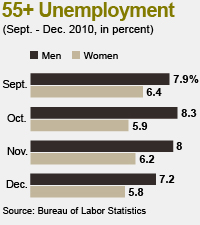
The outlook for older workers also turned slightly rosier in December. For 55-plus job seekers, the rate dropped to 6.9 percent from November’s rate of 7.2 percent.

Though the number of jobs added to the economy was lower than what analysts predicted, the latest labor report indicates a stronger recovery, says Gus Faucher, director of macroeconomics at Moody's Analytics outside Philadelphia. "Everything is pointing in the right direction. The economy is adding jobs, businesses are hiring and businesses will boost their hiring through 2011," Faucher says.


Full Article
Enhanced by Zemanta

Wednesday, December 22, 2010

Employment and Aging: Using Large Scale Data To Ask, “Who Works?” | Aging In Action

by John Davy on December 21, 2010

The so-called Great Recession has changed how Americans view work, and not just due to our 10% unemployment rate. Attacks on social security and pensions, the disappearing social safety net, and the need for many older adults to support younger family members (at a life stage when both had perhaps once expected that support would flow in the opposite direction) has delayed or ended retirement for many Americans. At the same time, job prospects for the long-term unemployed are sufficiently poor—which, as we recently discussed, particularly afflicts older adults—that many are forced into undesired, unfunded retirement.

In our recent article on employment and aging, we discussed why older adults struggle to find work, compared to younger cohorts. This may lead one to ask: what are the factors that lead older adults to search for new work? Clearly, unemployment, the loss of pensions, and the need to support spouses, children and grandchildren all lead individuals to take on new employment. Beyond individual circumstances, however, are there structural factors that influence who works? What can we learn about differences between communities, classes, ethnic groups, and regions in terms of which older adults seek out and take on work?

Full Article
Enhanced by Zemanta

Friday, September 17, 2010

Census Report Adds Four Million to Ranks of Uninsured from MedPage Today

By Joyce Frieden, News Editor, MedPage Today

The number of uninsured Americans is at an all time high, while the number of people covered by employment-based insurance is at an all time low, according to the latest numbers from the Census Bureau.

The number of people without health insurance coverage jumped by four million from 46.3 million in 2008 to 50.7 million in 2009, while the percentage increased from 15.4% to 16.7% over the same period, the bureau said in its report, "Income, Poverty, and Health Insurance Coverage in the United States."

The report also noted that the percentage of people covered by private insurance (63.9%) is the lowest since 1987, when comparable health insurance data were first collected, as is the percentage of people covered by employment-based insurance (55.8%).

On the other hand, the percentage of people covered by government health insurance programs (30.6%) is the highest since 1987, according to the report.
Full Article
Enhanced by Zemanta

Saturday, September 4, 2010

Employment Picture Darkens in August, Jobless Rate for Older Men Record High - AARP Bulletin

by: Carole Fleck

The U.S. employment picture worsened slightly in August as the jobless rate edged higher and 54,000 jobs were lost overall, the government reported Friday.

The unemployment rate rose to 9.6 percent last month after holding steady at 9.5 percent in June and July. The number of people out of work climbed to 14.9 million in August, up from 14.6 million in the previous two months.

Private employers added a modest 67,000 jobs in August, with most of the hires in the health care, mining and temporary services industries. But this gain was more than offset by the government shedding 121,000 jobs from its payrolls, including 114,000 temporary census workers, according to the report by the Bureau of Labor Statistics.
For men age 55 and older seeking work, the labor market was especially difficult. Their unemployment rate rose from 7.7 percent in July to 8.4 percent in August, the highest for that demographic since the government began tracking data in 1948, says Sara Rix, a senior strategic policy adviser at AARP.

The jobless rate for women in that age group remained at 6.9 percent last month, the same as in July.
Continue Reading

Sunday, July 25, 2010

Recession deals a double blow to those both disabled and unemployed

new symbol wheelchair
Image by RodolfoManfredi via Flickr
By Donna St. George Washington Post Staff Writer

If he had his wish, Alex Maltby would be working with autistic children as a classroom aide, the best job he ever had. Instead, he is at his mother's kitchen table in Silver Spring pondering job possibilities -- 33 years old and visually impaired, looking for a way to make a living. The search has gone on and on.


It is a brutal job market for many workers, but even more so for those with disabilities, who can struggle in the best of times. For them, the unemployment rate is now 14.4 percent -- 50 percent higher than it is for other workers, and the jobs gap is larger still because so many are not counted as being in the workforce.

"The job situations for many people with disabilities are more precarious and less stable," says John Butterworth, a senior research fellow at the Institute for Community Inclusion at the University of Massachusetts in Boston.
Continue Reading
Enhanced by Zemanta

Saturday, June 26, 2010

Disability.gov: One-Stop Career Centers

By Guest Blogger Randee Ellen Chafkin, Employment and Training Administration

As we work to recover from the recession, Americans are struggling to find jobs - a challenging task considering that there is a current unemployment rate of 9.1 percent for the general population. When we take a look at the unemployment rate of people with disabilities, a group that has long been unemployed and underemployed regardless of the country’s current economic status, it is higher at 14.7 percent. And this statistic does not even include jobseekers with disabilities who have become discouraged and are not actively searching for employment.

Important resources for people seeking employment, including individuals with disabilities, are the public One-Stop Career Centers available in each state. The U.S. Department of Labor funds 1855 Comprehensive One-Stop Career Centers around the country which have specialized programs in career development, job placement and re-employment assistance. These are state networks of conveniently located community centers that provide employment, education and training services. Within the One-Stop Centers, there are representatives from several government agencies to assist jobseekers, including but not limited to Vocational Rehabilitation, Social Security and Veterans Benefits.

However, people with disabilities often fear that they will lose their cash assistance and disability-specific health benefits if they return to the workforce. As a result, the U.S. Department of Labor’s Employment and Training Administration (ETA), in collaboration with the Social Security Administration’s Office of Program Development, entered into cooperative agreements with selected states to establish the Disability Program Navigator (DPN) program in workforce investment areas and One-Stop Career Centers throughout the country. This program emphasizes the crucial role that knowledgeable and expert staff support plays in enhancing One-Stop services for job seekers with disabilities.

A Navigator is a dedicated expert staff person knowledgeable about employment-related resources and supports for individuals with disabilities in and outside the public workforce system to effectively:

Continue Reading Disability.gov: One-Stop Career Centers
Enhanced by Zemanta

Tuesday, June 8, 2010

TIME GOES BY | Grateful to Be Retired

by Ronni Bennet
Among the stray thoughts that roll around in my head, one repeats itself every time I see a news story about unemployment, underemployment and recession-related job advice: how grateful I am that I am no longer in the workforce.

Retiring was not on my agenda when I was forced into it five years ago, but after a year of futile searching for work, there was no longer another choice. It was painful to accept that my working years were finished but as much as I would have preferred to find a job (I really liked the kind of work I did in those days), I was relieved to leave behind the new employment rules.

Among those rules, which pertain even more so one recession and half a decade later, are these:

To sell yourself to prospective employers, you must create a “personal brand” - make yourself as individually identifiable as Coca-Cola or Apple or Tampax.

You must erase from your resume all but the last ten years of your career. Anything you learned or accomplished before then is not only irrelevant, it might – god forbid – suggest you are older than 35 which, apparently, has become the age at which workers become too old for paid employment.

If someone does offer you a position, you must be prepared to accept a salary of less than half what you were paid on your previous job for the same or similar work. Understand, too, that you are likely to be hired as an independent contractor which means zero benefits.

This stuff is what the job experts tell job seekers these days. They are also cheer leaders for self-employment. Start your own company, they say, become an entrepreneur, hire others to work for you, be the big cheese. Entrepreneurship is all the rage, we are told, taking America by storm. Even the statistics back up the claim.

According to the Kauffman Index of Entrepreneurial Activity, as reported by former Secretary of Labor Robert Reich in The New York Times earlier this week:
“'Rather than making history for its deep recession and record unemployment,' the foundation reported, '2009 might instead be remembered as the year business startups reached their highest level in 14 years — even exceeding the number of startups during the peak 1999-2000 technology boom.'

“According to the report,” writes Reich, “most of the growth in startups was propelled by 35- to 44-year-olds, followed by people 55 to 64. Forget Internet whiz kids in their 20’s. It’s the gray-heads who are taking the reins of the new startup economy.”
Sounds pretty good, doesn't it. Exciting, even. And all those older folks leading the way? Wow. Except almost none of those people intend to become entrepreneurs which, contrary to the hype, is almost always about treading water as an independent contractor, not a new business owner.

Because they have been unemployed for months and even years, because they have used up their 401(k)s and IRAs just to stay afloat, they have been forced into trying to work for themselves. It is the only choice left.

As Reich notes in the Times story:
“While some are happy about their new status, most are worse off than they were before. It’s one thing to be a contingent worker in good times and when you’re young; quite another in bad times when you’re middle-aged.”
No kidding. My last job was as an independent contractor. There were no paid holidays, sick leave or vacations. I was required to pay the corporate half of FICA and Medicare taxes as well as my own. I bought my health coverage at an astronomical price on the individual market and couldn't save a dime; I was making less than two-thirds of my previous salary before all the extra expenses.

When another mass layoff came around, my staff colleagues, with whom I had worked side-by-side (and in some cases supervised), collected unemployment insurance benefits until they found new jobs; I was ineligible because I was a contractor.

Even before the recession, the world of work was changing for the worse. With the dramatic unemployment statistics these past two years, people forget that for the previous decade and more, corporate America was already laying off workers in large numbers and sending jobs to low-wage countries. The recession just accelerated the practice, and none of those jobs will ever come back to the United States.

Eventually, some years down the line, we will pull out of this recession (no, I do not believe it is over, whatever government figures say), but the employment world will never again look like it did during our working years.

I don't want to “brand” myself. I know my early- and mid-career experience made my late career both possible and as successful as it was. And whatever those experts try to tell us, working for myself was a bummer. Some of us do not have the skills (or interest) to run a company, even a company of one.

But those are the requirements now and every day I am grateful that I don't need to be searching for work in this new employment world. In certain eras, I think it is a good thing to be among the elders.
Reblog this post [with Zemanta]

Sunday, January 31, 2010

Average retirement age has increased in Finland

Finnish FlagImage by Bishwo Ghimire via Flickr

from HELSINGIN SANOMAT INTERNATIONAL EDITION Somewhat surprisingly, the average age of retirement in Finland rose from 59.4 in 2008 to 59.8 last year, regardless of the ongoing recession and rising unemployment.

Experts have been rather taken aback by the fact that the average age of retirement in Finland rose noticeably from 59.4 in 2008 to 59.8 last year, in spite of the ongoing recession and rising unemployment figures.

In comparison, the pension age in 1999 was below 59 years.
The pension age keeps rising, as the rules have been changed and as people also live longer.

The increase as such is in line with the forecasts made following the major pension reform of 2005 that introduced a so-called flexible retirement age from 63 to 68 years. The objective of the pension reform was to encourage employees to stay at work longer.

However, a severe economic decline hit the country, and news stories on senior employees being urged to take retirement were reported from various parts of the country. At the same time, it has been said those employees suffering from burnout have left the workforce prematurely since they have been granted disability pensions.

This development has nevertheless not been reflected in retirement figures - at least not yet.

Continue Reading
Reblog this post [with Zemanta]