Showing posts with label lifestyle. Show all posts

Tuesday, March 29, 2011

Calling All Beautiful Minds

The National Center for Creative Aging (NCCA) is an organization dedicated to fostering an understanding of the vital relationship between creative expression and the quality of life of older people. NCCA has partnered with Martek Biosciences, a company committed to brain health research, to help shine a light on people who are keeping their minds beautiful, and raise awareness of the actions people can take to maintain the most important organ in the body—the brain.

NCCA and Martek are seeking people 55 and over to be featured in a national photo essay exhibit showcasing women and men who are doing beautiful things with their minds without letting age be a barrier. The photo essay exhibit will travel to multiple cities as part of this educational campaign to inspire all Americans to follow suit in maintaining their brain health.

Beautiful Minds candidates who are selected will receive $500 to be given to the nonprofit charity of their choice and a prize package valued at $500.

Nominate by May 13, 2011.


Enter Now

Beautiful Minds Essay Criteria

If you are 55 or over, and have looked at aging as an opportunity to do something extraordinarily beautiful with your mind, you are a good candidate.
Do you or does someone you know:
· Commit to a healthy lifestyle?
· Maintain a healthy diet?
· Engage in intellectual or brain-healthy activities on a daily basis?
· Take measures to overcome a serious illness through mind, body, spirit and nutritional methods?
· Receive accolades for work as an educator?
· Participate in high-impact physical activities, such as running marathons?
· Have a strong commitment to social well-being and volunteer to help others?
Enter Now
Click here for rules and regulations


Enhanced by Zemanta

Saturday, October 30, 2010

New Research Demonstrates the Value of Social Connectedness for Older Adults

by Richard Shank on October 29, 2010

The research reported in this article is not directly about the move-in process into Long Term Care (LTC) or Senior Living (SL); however, it implies that competitive organizations will have to recreated the same sense of community within their residence that older adults feel they have left behind when they move in.

Researchers from University of South Carolina outlined the importance of salient social connections in the lives of older adults. “Salient connections…form the basis for all human existence and it is the phenomenon of connectedness that brings quality of life.” This seemingly commonsensical statement is far too often taken-for-granted and thus overlooked by many. Just as in the1980s when economists had to be reminded that market relationships are embedded in a web of social connections, today many service providers can stand to benefit from being reminded that the social connections their residents have help drive the satisfaction and quality of life of their residents. Additionally, these social connections help shape the decision to move into your residence. So paying attention to the social needs and relationships of residents or potential residents will help both program development and marketing.
Full Article
Enhanced by Zemanta

Wednesday, October 20, 2010

RLTV - TV for Boomers and Older Individuals

Retirement Living TVImage via Wikipediaby Lowell Dempsey

There has been plenty of coverage lately on the importance of the youth vote on Election Day. It's as though politicians think older voters - one in three Americans - can be taken for granted.

The readers of Aging And Disability In America probably don't know John Erickson, but they should. John is the Chairman of RLTV and founder of Erickson Retirement Communities, and is leading the way in making sure that the voices of Americans 55 and older are heard.  People 55+ - and that includes John himself - make up one-third of America and care deeply about not only issues that affect them personally, but also how today's decisions will affect the future for their children and grandchildren.

John's rallying call to this powerful group of 70 million Americans can be found here:

http://johnerickson.tv

He's also led the way on RLTV with Prime Votes, an initiative to help inform boomers and seniors about the important issues in the mid-term elections.  Prime Votes features nightly updates with Sam Donaldson and John Palmer as well as two national forums hosted by Cokie Roberts to air this week on RLTV and C-SPAN.

More about Prime Votes, as well as John's discussion of many important national issues, can be found at the johnerickson.tv site. 
Enhanced by Zemanta

Sunday, October 10, 2010

Despite high healthcare spending, America is lagging in life expectancy | Healthcare Finance News


by Chelsey Ledue, Associate Editor

Despite spending a lot of money on healthcare, the United States continues to lag behind other nations when it comes to gains in life expectancy, according to a Commonwealth Fund-supported study published today as a Health Affairs Web First.

The study looked at health spending, behavioral risk factors like obesity and smoking and 15-year survival rates for men and women ages 45 and 65 in the United States and 12 other countries (Australia, Austria, Belgium, Canada, France, Germany, Italy, Japan, the Netherlands, Sweden, Switzerland, and the United Kingdom).
Full Article
Enhanced by Zemanta

Monday, September 13, 2010

How to Know and Be in Flow

by Mike Kirkeberg

Older and wiser than I have been before, I hope I have learned a few things. As I age and sometimes have to work harder to stay fit and in tune with myself, more and more I realize that I don’t want – and can’t spare – any wasted time. Does this fit for you?

I want to use my time as often as I can doing things that really connect me with my self. I think the baby boomer generation has always been like this, and, at least for me, it has developed into something that feels pretty important in my life.

You have all probably heard of Mihály Csíkszentmihályi and his theory of flow. His books have described it as a feeling of timelessness, challenge, and yet ease. In a sense it can be a home grown peak experience. I created a video that delves briefly into what it takes to get to the flow experience, and what it is to be in it. I’m not an expert. I am just interested and wanted to share what I’ve learned with you.

Enhanced by Zemanta

Friday, July 23, 2010

Idling Toward Death from MedPage Today

By Todd Neale, Staff Writer, MedPage Today
Sitting around too much in one's spare time appears to increase the risk of dying,regardless of physical activity, researchers found.
Among more than 120,000 adults, those who sat more than six hours a day in their leisure time were significantly more likely to die in a 14-year period than those who sat less than three hours (P<0.0001), According to Alpa Patel, PhD, of the American Cancer Society in Atlanta, and colleagues.
The association was stronger in women (RR 1.34, 95% CI 1.25 to 1.44)than in men (RR 1.17, 95% CI 1.11 to 1.24), the researchers reported online in the American Journal of Epidemiology.

The findings were independent of physical activity levels, body mass index, smoking, and several other factors contributing to mortality risk.
According to the researchers, sedentary time may be related to mortality risk because sitting may be associated with other unhealthy behaviors, like excessive eating. In addition, sitting too much could have adverse metabolic effects.
Continue Reading

Tuesday, June 29, 2010

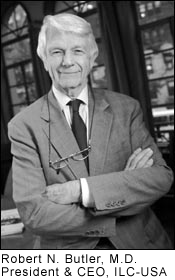
The Longevity Prescription - New Book by Robert Butler, MD

In The Longevity Prescription, The 8 Proven Keys to a Long, Healthy Life, ILC-CEO Dr. Robert Butler outlines eight essential facets of longevity: exercise, nutrition, mental vitality, sleep, relaxation, love and intimacy, community connections, and medical care. Based on proven discoveries, the strategies in each of these areas stretch the proceeds of the "three­decade dividend" while delaying or eliminating chronic illness. In The Longevity Prescription, readers will learn:
  • why honing a center of balance is essential to physical health
  • how to watch out for food additives and their damaging effects
  • why it's important to establish a bedtime routine
  • how starting a second career in retirement can be key to self- contentment, and more
With step-by-step guidance for formulating an action plan and adopting new habits and strategies, The Longevity Prescription also guides readers through special challenges, suchas diabetes and cancer. Emphasizing clear-cut research findings that balance physical health with emotional well­being, Butler and his colleagues offer a definitive path to whole-life happiness.

All author royalties will go to the International Longevity Center-USA


Enhanced by Zemanta

Wednesday, June 2, 2010

TIME GOES BY | Resting My (Aging) Mind

by Ronni Bennett

What a good conversation there was on last Friday's post about old age coming on more quickly than I had imagined it would. Obviously, I'm in good company in my surprise.
A comment from Jan Adams of the blog Happening Here and her monthly TGB column, Gay and Gray, seemed particularly apt to me yesterday, although slightly askew from the way she intended:
“For me, the symptom of aging that shocks me (a little) is not the getting tired - but the slowness of recovery,” wrote Jan. “I can still do most of what I've done for the last 50 years physically, but my body lets me know I am not to repeat that exertion for a longer period.”
Recovery time is needed, I think, not only from physical exertion, but from the mental/emotional variety too. My body is rested (or so I believe), but it's taking my mind longer to find its usual pace again. After two or three months of lists, sub-lists, phone calls, arrangements, organization, reminders, follow-ups, course corrections and numerous fixes to inevitable problems, my brain has told me it's on hold for awhile - even though most of project is finished.

Continue Reading

Saturday, April 24, 2010

Death of 'Caveman' ends an era in Idaho | Local News | Idaho Statesman

BY TIM WOODWARD - twoodward@idahostatesman.com

Known as the "Salmon River Caveman," Richard Zimmerman lived an essentially 19th century lifestyle, a digital-age anachronism who never owned a telephone or a television and lived almost entirely off the land.

"He was in his home at the caves at the end, and it was his wish to die there," said Connie Fitte, who lived across the river. "He was the epitome of the free spirit."

Richard Zimmerman had been in declining health when he died Wednesday.

Few knew him by his given name. To friends and visitors to his jumble of cave-like homes scrabbled from a rocky shoulder of the Salmon River, he was Dugout Dick.

He was the last of Idaho's river-canyon loners that date back to Territorial days. They are a unique group that until the 1980s included canyon contemporaries with names like Beaver Dick, Cougar Dave and Wheelbarrow Annie, "Buckskin Bill" (real name Sylvan Hart) and "Free Press Frances" Wisner. Fiercely independent loners, they lived eccentric lives on their own terms and made the state more interesting just by being here.

Read more: http://www.idahostatesman.com/2010/04/23/1164899/death-of-caveman-ends-an-era-in.html#ixzz0m16K3wpQ
Reblog this post [with Zemanta]

Thursday, February 25, 2010

Demand grows for multi-generational housing - Lansner on Real Estate : The Orange County Register

by Jonathan Lansner and and Jeff Collins

Who knew that the mother-in-law room would become so trendy?

A Coldwell Banker survey of its sales staff found multi-generational homes as a burgeoning trend for homebuyers and sellers alike. Response to the poll found, that in the past 12 months:

* 37% of the 2,360 Coldwell Banker agents polled noted increases in homebuyers looking to purchase homes to accommodate more than one generation of their family.
* 39% of homebuyers or sellers who are moving into a house with other generations of their family did so with financial considerations as primary reason for the move.
* 29% cited care issues as primary reason.
* 6% cited a strong family bond.

Continue Reading
Reblog this post [with Zemanta]

Tuesday, January 26, 2010

Mastering his mind | The Times Leader, Wilkes-Barre, PA

by KRISTA JAHNKE

Tickle the bottom of Matthew Sanford’s foot, and he won’t feel it.

He’s been paralyzed from the chest down since a car accident more than 30 years ago.

But squeeze his ankles — really squeeze them — and he’ll sense it. A subtle energy, a sort of hum, will rush from his bone and spark to life in his brain.

Help Sanford onto a yoga mat, and the 44-year-old who hasn’t walked since he was 13 will achieve poses that trouble even the strongest able-bodied practitioners.

Not that that’s the point.

His message is not about how he is able, despite being disabled. It’s about how we all can live more fully in our bodies with a stronger mind-body connection. And don’t you dare say he overcame anything, he says.

Continue Reading

Tuesday, January 12, 2010

Time Watching TV Linked to Greater Risk of Death, New Study Says - WSJ.com

couch potatoImage by Runs With Scissors via Flickr

By RON WINSLOW

If you're reading this sitting down, you might consider standing up.

In a provocative look at the impact of sedentary behavior on health, a new study links time watching television to an increased risk of death. One of the most surprising findings is that it isn't just couch potatoes who were affected—even for people who exercised regularly, the risk of death went up the longer they were in front of the TV. The problem was the prolonged periods of time spent sitting still.
Continue Reading


Reblog this post [with Zemanta]

Tuesday, December 16, 2008

Future of the Internet III: How the Experts See It

by Janna Quitney Anderson, Director, Imagining the Internet, Elon University and Lee Rainie, Director, Pew Internet & American Life Project December 14, 2008 A survey of internet leaders, activists and analysts shows they expect major technology advances as the phone becomes a primary device for online access, voice-recognition improves, artificial and virtual reality become more embedded in everyday life, and the architecture of the internet itself improves. Here are the key findings in a new report based on the survey of experts by the Pew Internet & American Life Project that asked respondents to assess predictions about technology and its roles in the year 2020:
  • The mobile device will be the primary connection tool to the internet for most people in the world in 2020.
  • The transparency of people and organizations will increase, but that will not necessarily yield more personal integrity, social tolerance, or forgiveness.
  • Voice recognition and touch user-interfaces with the internet will be more prevalent and accepted by 2020.
  • Those working to enforce intellectual property law and copyright protection will remain in a continuing "arms race," with the "crackers" who will find ways to copy and share content without payment.
  • The divisions between personal time and work time and between physical and virtual reality will be further erased for everyone who is connected, and the results will be mixed in their impact on basic social relations.
  • "Next-generation" engineering of the network to improve the current internet architecture is more likely than an effort to rebuild the architecture from scratch.

Tuesday, August 26, 2008

Living Longer, in Good Health to the End

Living Longer, in Good Health to the End By JANE E. BRODY Published: August 26, 2008, New York Times Getting older doesn’t have to mean getting frailer. . . . there is increasing evidence that the societal burden of increased longevity need not be so drastic. Long-term studies have shown that how people live accounts for more than half the difference in how hale and hearty they will remain until very near the end.

Monday, August 4, 2008

Creating currency to care for the elderly

By Maggie Mahar in the Health Care Blog Did you know that Japan has found an ingenious way to “create” money that can be used to care for the elderly?

Friday, August 1, 2008

Lifestyle and Alzheimer's Disease

A new study suggests that those who are unmarried or not living with a partner in midlife could have an increased risk of developing Alzheimer's disease, according to research reported at the 2008 Alzheimer's Association International Conference on Alzheimer's Disease (ICAD 2008), in Chicago. Additional research on Alzheimer risk factors presented at ICAD 2008 indicates that people who ruminate, or repeatedly think about their problems, may be less likely to develop the disease, while people with metabolic syndrome (a combination of cardiovascular health related symptoms) are at higher risk. Finally, a large meta-analysis of nine European risk factor surveys confirmed a well recognized group of Alzheimer risk factors, including memory complaint, severe head trauma, diabetes, stroke and low education. "We may not be able to do anything about aging, genetics or family history, but research shows us that there are lifestyle decisions we all can make to keep our brains healthier as we age, and that also may lower our risk of developing Alzheimer's disease," said William Thies, PhD, vice president of Medical and Scientific Relations for the Alzheimer's Association.

In Strangers, Centenarian Finds Literary Lifeline

By SARAH KRAMER Published: August 1, 2008, New York Times A cadre of devoted friends read to Elizabeth Goodyear, who is 101, blind and confined to her Manhattan apartment.

Monday, July 21, 2008

Hispanic community sees weight-loss gains

By Jessica Jackson Staff Writer, Daily Oklahoman Published July 20 More than 100 people gathered Saturday morning at Rancho Village Baptist Church in Oklahoma City to celebrate their health and weight loss, ending a 12-week program designed to infuse better lifestyle habits into the Hispanic community. The first Hispanic Weight Loss Challenge, called "Gane ... Perdiendo,” or "Win ... Losing,” was started by two Integris Heath workers who noticed a need to improve their lives.

Sunday, July 20, 2008

Study: Regular walking nearly halves elderly disability risk

Older adults can decrease their risk of disability and increase their likelihood of maintaining independence by 41 percent by participating in a walking exercise program, according to a new University of Georgia study. The study, which appears in the current issue of the Journal of Geriatric Physical Therapy, also found that walking program participants increased their peak aerobic capacity by 19 percent when compared to a control group and increased their physical function by 25 percent.

Who Wants to Retire Later? (Don’t Laugh)

By HARRY HURT III Published: July 20, 2008, New York Times

In their new book, Alicia H. Munnell and Steven A. Sass argue that we may have to work longer and retire later if we want to avoid a decline in our standard of living.