Showing posts with label infections. Show all posts

Friday, January 14, 2011

Private Room Intensive Care Units Associated with Lower Infection Rates

ScienceDaily (2011-01-13) -- Converting hospital intensive care units to private rooms is associated with a reduction in the rate at which patients acquire infections, according to a new study.

Saturday, September 18, 2010

Fun Hand Hygiene Movements Combined with Dance Moves

CDC HandwashingVideo

Healthcare-Associated Infection: Not on My Watch - Kimberly-Clark Health Care

Join the community of healthcare professionals concerned with preventing Healthcare-Associated Infections (HAIs), which at any given moment seriously affect 1.4 million hospitalized patients worldwide.

The HAI WATCHDOG* forums are intended to provide a place for health care providers to discuss issues and best practices related to Hospital-Associated Infections (HAIs).

Kimberly-Clark is committed to helping win the battle to prevent HAIs. As part of that effort, we are pleased to sponsor this new community site for healthcare providers to discuss HAI without discussion of product-specific information.

HAI WATCHDOG* Community members can:
  • Participate in discussions or start your own
  • Post HAI-related videos, photos or links to articles
  • Enter the 2010 HAI WATCHDOG* Awards and read and vote on others' entries; this is an excellent way to share initiatives to reduce HAIs and have the opportunity to be recogized with an educational grant
  • Spread the word in your facility about your own HAI initiatives by creating customized HAI Commitment posters online; then print or email them to others
  • Help this community grow by inviting others to join the HAI WATCHDOG* Community
Healthcare-Associated Infection: Not on My Watch - Kimberly-Clark Health Care
Enhanced by Zemanta

Saturday, September 4, 2010

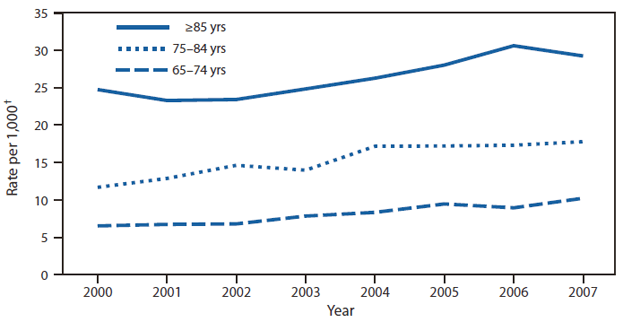
QuickStats: Hospitalization Rates for Patients Aged ≥65 Years with Septicemia or Sepsis,* by Age Group --- National Hospital Discharge Survey, United States, 2000--2007

September 3, 2010 / 59(34);1108
The figure shows hospitalization rates for patients aged ≥65 years with septicemia or sepsis, by Age Group, in the United States from 2000-2007. Results derived from the National Hospital Discharge Survey. Septicemia and sepsis are bloodstream infections. From 2000 to 2007, the rate of hospitalization for septicemia or sepsis for persons aged 65-74 years increased 57%, from 6.5 per 1,000 to 10.2, and the rate for persons aged 75-84 years increased 52%, from 11.7 to 17.8. During 2000-2007, persons aged ≥85 years had higher rates of hospitalization for septicemia or sepsis than persons aged 65-84 years. From 2000 to 2007, rates for persons aged ≥85 years increased 18% percent, from 24.7 per 1,000 to 29.2.
*Septicemia or sepsis hospitalizations are those with a diagnosis code of 038, 995.91, or 995.92, based on the International Classification of Diseases, Ninth Revision, Clinical Modification, in any of seven diagnoses fields of the National Hospital Discharge Survey.

† Inpatient hospitalization rates for 2000--2007 were calculated using U.S. Census Bureau 2000--based postcensal civilian population estimates. Persons might have multiple inpatient septicemia or sepsis hospitalizations, all of which are reflected in the estimates.

Septicemia and sepsis are bloodstream infections. From 2000 to 2007, the rate of hospitalization for septicemia or sepsis for persons aged 65--74 years increased 57%, from 6.5 per 1,000 to 10.2, and the rate for persons aged 75--84 years increased 52%, from 11.7 per 1,000 to 17.8. During 2000--2007, persons aged ≥85 years had higher rates of hospitalization for septicemia or sepsis than persons aged 65--84 years. From 2000 to 2007, rates for persons aged ≥85 years increased 18%, from 24.7 per 1,000 to 29.2.

SOURCE: National Hospital Discharge Survey, annual files, 2000--2007. Available at http://www.cdc.gov/nchs/nhds.htm.
Full Article
Enhanced by Zemanta

Friday, January 29, 2010

Award Winning Author and Patient Advocate Releases "The Patient Safety Checklist" to Prevent Medical Errors in Hospitals

Surgical safety checklists have been shown to be very effective in significantly reducing fatal medical errors when used by surgeons and members of the surgical team. (See Harvard study.) Martine Ehrenclou, author of the multiple award winning book, Critical Conditions: The Essential Hospital Guide To Get Your Loved One Out Alive, has created "The Patient Safety Checklist" for patients and their advocates to further close the gap on preventing medical errors in hospitals.

Ehrenclou created "The Patient Safety Checklist" for hospitalized patients and their family members to work together with the medical professionals in increasing the likelihood that a hospitalized patient will not fall victim to deadly medical errors. "A collaborative effort is needed," states Ehrenclou. "With the pressure physicians and nurses are currently under, patients and their family members must get involved in the hospitalized patient's medical care."

Continue Reading
Reblog this post [with Zemanta]

Not on My Watch Campaign To Eliminate Hospital Acquired Infections

Thursday, November 5, 2009

Healthcare-Associated Infection: Not on My Watch - Kimberly-Clark Health Care

When someone develops an infection at a hospital or other patient care facility that they did not have prior to treatment, this is referred to as a healthcare-associated (sometimes hospital-acquired) infection (HAI).

Healthcare-associated infections (HAIs) are a global crisis affecting both patients and healthcare workers.

According to the World Health Organization (WHO), at any point in time, 1.4 million people worldwide suffer from infections acquired in hospitals.

A Centers for Disease Control (CDC) report published in March-April 2007 estimated the number of U.S. deaths from healthcare asociated infections in 2002 at 98,987.

The risk of acquiring healthcare-associated infections in developing countries is 2-20 times higher than in developed countries.

Afflicting thousands of patients every year, HAI often leads to lengthening hospitalization, increasing the likelihood of readmission, and adding sizably to the cost of care per patient.
Read More

Tuesday, October 20, 2009

Hospital Workers May Trigger Dangerous Outbreaks - Forbes.com

(HealthDay News) -- Hospital workers who see many patients may play a disproportionate role in spreading dangerous hospital-acquired infections, a new study finds.
Continue Reading
Reblog this post [with Zemanta]

Tuesday, September 29, 2009

The Health Care Blog: Medicare Policy Might Discourage Proper Care for Hospital-Acquired Infections

A Medicare card, with several areas of the car...Image via Wikipedia

By MAYA SEQUEIRA

Medicare's recent policy of refusing to pay hospitals' additional costs to treat hospital-acquired infections fails to adequately incentivize prevention and proper treatment of these complications, associated with 99,000 deaths annually. A recent analysis by Peter McNair and colleagues in the journal Health Affairs suggests that, in the entire state of California, only 11 hospitalizations complicated by infection would have received lower reimbursement as a result of the policy if it had been in place in 2006.

The Medicare policy focuses on infections that have low mortality, such as catheter-associated urinary tract infections, and infections that affect few people, such as mediastinitis after CABG surgery. This means that the vast majority of severe hospital-acquired infections remain completely unregulated.
Continue Reading
Reblog this post [with Zemanta]

Saturday, September 27, 2008

California Mandates More Screening, Reporting of Hospital Infections

Posted by Jacob Goldstein in the Wall Street Journal Health Blog Here’s one more sign of the growing concern over the nasty infections that pass from patient to patient at American hospitals: Four years ago, Gov. Schwarzenegger vetoed a bill that would have given hospitals more responsibility in tracking and reporting infections. Yesterday, he signed into law two bills that do just that, the Los Angeles Times reports.