Sunday, September 5, 2010

The Medicare Headline You Didn't See (and won't) | Angry Bear

Centers for Medicare and Medicaid Services - M...Image via Wikipediaby Bruce Webb

For years we have been regaled with scary, scary numbers about how Medicare's projected unfunded liability was in the TENS OF TRILLIONS. And sure enough if you consulted the Medicare Report and examined the actuarial projections for Medicare Part A you would find that number. But a funny thing happened with the 2010 Report and is shown in the data table above: the 75 year number is down to $6.9 trillion, a big number but only 0.5% of projected GDP over that period, and the infinite future number is actually a $600 billion SURPLUS.

Continue Reading
Enhanced by Zemanta

Saturday, September 4, 2010

Making Social Security less generous isn't the answer

Ezra Klein at YearlyKos 2007Image by Son of Broccoli via FlickrBy Ezra Klein

There are a lot of things Congress doesn't know right now. What to do about jobs, for instance. Who'll be running the House come January. How to balance the budget. But there is one thing that both parties increasingly seem to agree on: You should work longer.

Raising the Social Security retirement age has become as close to a consensus position as exists in American politics. House Minority Leader John A. Boehner (R-Ohio) supports it. House Majority Leader Steny H. Hoyer (D-Md.) has said that "we could and should consider a higher retirement age." And for a while, I agreed with them, too. It seemed obvious: People live longer today, and so they should work later into life. But as I've looked at the issue, I've decided that I was wrong. So let me be the skunk at the party. We should leave the retirement age alone. In fact, we should leave Social Security alone -- unless we're making it more, rather than less, generous.

Read Full Article
Enhanced by Zemanta

National Women's Law Center: Survey - Webinars: Women and Retirement Security (September 2010)

As women think about retirement, they may take stock of their savings and realize they don't have enough saved — and they don't know what to do with the savings they do have. They may not know what benefits they can get from Social Security, and how their decisions about when to claim benefits (and their husband's, if they are married) can affect the benefits they receive.

Don't panic! The National Women's Law Center is hosting a two-part series of free webinars to help women prepare for retirement, for service providers, advocates, and individuals.

Planning for the Future: What Women Need to Know About Social Security will be held on Wednesday, September 8, 2010 at 1:00 p.m. Eastern (1 hour).

Featured speakers will include:
  • Joan Entmacher, National Women’s Law Center
  • Maria Freese, National Committee to Preserve Social Security and Medicare
Planning for the Future: What Women Need to Know About Pensions and Savings will be held on Thursday, September 16, 2010, at 1:00 p.m. Eastern (1 hour).

Featured speakers will include:
  • Amy Matsui, National Women’s Law Center
  • Rebecca Davis, Pension Rights Center
  • Kathy Stokes Murray, Women's Institute for a Secure Retirement (WISER)
These webinars are free to participants, but registration is required.
Link to Registration
Enhanced by Zemanta

“Young Guns” Are Gunning for Your Social Security & Medicare | Entitled to Know

By NCPSSM

House Republican leaders have given Americans a glimpse of the GOP agenda to privatize Social Security and end Medicare as we know it. The messengers for this campaign immodestly call themselves the “Young Guns”. Unfortunately, what they’ve really taken aim at are the benefits working Americans have paid for throughout their lives.

In an over-the-top video chock full of waving flags and slow motion walking shots, meant to evoke every American action hero since Superman, Republican Whip Eric Cantor, Deputy Whip Kevin McCarthy and Ranking Budget Committee member Paul Ryan attempt to sell their new book repackaging the same old anti-Social Security dogma that dates back to the days of Alf Landon. Obviously, convincing Americans they don’t need Medicare and Social Security will be an especially tough sell these days, as Americans continue to suffer in this recession, so this time GOP leaders are wrapping their proposals in the best marketing PAC money can buy. They claim privatization and ending Medicare are “innovative” and “energetic” proposals offered by a “new generation” of leaders. Huh?

Why would the “Young Guns” release a book and Hollywood style video rather than introducing a piece of legislation? Here’s an easy answer to that question:
Read Full Article

That pension? You might have to pay it back | pension, plan, yore - Home - The Orange County Register

Northrop X-4Image via Wikipedia By TERYL ZARNOW

Ralph Yore made a career out of being careful. After 12 years in the Marines, including a tour in Vietnam, he began his life's work in aircraft maintenance. He was a quality control inspector and supervisor with the Department of Defense in Vietnam, for Bell Helicopters in Iran and several airlines. Eventually, in 1984, he landed at Northrop Grumman in Hawthorne.

Yore, 73, spent 17 years at Northrop ensuring in essence that planes didn't fall apart during flight. Small things like that.

Now, in his retirement, another small thing has knocked him sideways.

When this husband and father of two took early retirement in 2001, he began receiving pension payments of $2,937.93 per month.

In April of 2009, he received a letter saying that an audit discovered a mistake: For the past eight years he had been paid $1,261 per month too much. His payments should have been reduced when he began collecting Social Security.

Yore's payments were corrected to $1,676.93 per month.

The letter came from Vought Aircraft that inherited his pension plan when it was split from Northrop. Vought is now part of the Triumph Group.

In March of 2010, Yore received a second letter: To recover the overpayment, the pension plan will deduct $709.40 per month. His new monthly payment is suddenly $967.53.
Read Full Article
Enhanced by Zemanta

Employment Picture Darkens in August, Jobless Rate for Older Men Record High - AARP Bulletin

by: Carole Fleck

The U.S. employment picture worsened slightly in August as the jobless rate edged higher and 54,000 jobs were lost overall, the government reported Friday.

The unemployment rate rose to 9.6 percent last month after holding steady at 9.5 percent in June and July. The number of people out of work climbed to 14.9 million in August, up from 14.6 million in the previous two months.

Private employers added a modest 67,000 jobs in August, with most of the hires in the health care, mining and temporary services industries. But this gain was more than offset by the government shedding 121,000 jobs from its payrolls, including 114,000 temporary census workers, according to the report by the Bureau of Labor Statistics.
For men age 55 and older seeking work, the labor market was especially difficult. Their unemployment rate rose from 7.7 percent in July to 8.4 percent in August, the highest for that demographic since the government began tracking data in 1948, says Sara Rix, a senior strategic policy adviser at AARP.

The jobless rate for women in that age group remained at 6.9 percent last month, the same as in July.
Continue Reading

Video of the National Commission on Fiscal Responsiblity and Reform: 1st Meeting

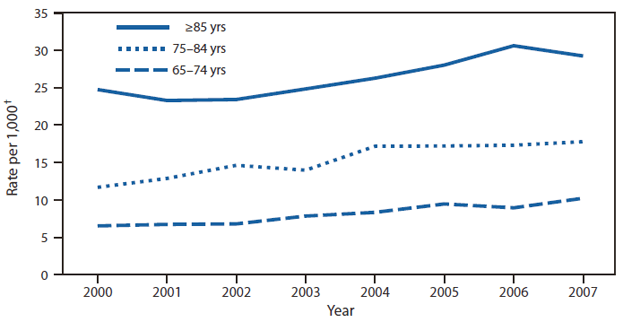
QuickStats: Hospitalization Rates for Patients Aged ≥65 Years with Septicemia or Sepsis,* by Age Group --- National Hospital Discharge Survey, United States, 2000--2007

September 3, 2010 / 59(34);1108
The figure shows hospitalization rates for patients aged ≥65 years with septicemia or sepsis, by Age Group, in the United States from 2000-2007. Results derived from the National Hospital Discharge Survey. Septicemia and sepsis are bloodstream infections. From 2000 to 2007, the rate of hospitalization for septicemia or sepsis for persons aged 65-74 years increased 57%, from 6.5 per 1,000 to 10.2, and the rate for persons aged 75-84 years increased 52%, from 11.7 to 17.8. During 2000-2007, persons aged ≥85 years had higher rates of hospitalization for septicemia or sepsis than persons aged 65-84 years. From 2000 to 2007, rates for persons aged ≥85 years increased 18% percent, from 24.7 per 1,000 to 29.2.
*Septicemia or sepsis hospitalizations are those with a diagnosis code of 038, 995.91, or 995.92, based on the International Classification of Diseases, Ninth Revision, Clinical Modification, in any of seven diagnoses fields of the National Hospital Discharge Survey.

Inpatient hospitalization rates for 2000--2007 were calculated using U.S. Census Bureau 2000--based postcensal civilian population estimates. Persons might have multiple inpatient septicemia or sepsis hospitalizations, all of which are reflected in the estimates.

Septicemia and sepsis are bloodstream infections. From 2000 to 2007, the rate of hospitalization for septicemia or sepsis for persons aged 65--74 years increased 57%, from 6.5 per 1,000 to 10.2, and the rate for persons aged 75--84 years increased 52%, from 11.7 per 1,000 to 17.8. During 2000--2007, persons aged ≥85 years had higher rates of hospitalization for septicemia or sepsis than persons aged 65--84 years. From 2000 to 2007, rates for persons aged ≥85 years increased 18%, from 24.7 per 1,000 to 29.2.

SOURCE: National Hospital Discharge Survey, annual files, 2000--2007. Available at http://www.cdc.gov/nchs/nhds.htm.
Full Article
Enhanced by Zemanta

Updated Recommendations for Prevention of Invasive Pneumococcal Disease Among Adults Using the 23-Valent Pneumococcal Polysaccharide Vaccine (PPSV23)

Invasive disease from Streptococcus pneumoniae (pneumococcus) is a major cause of illness and death in the United States, with an estimated 43,500 cases and 5,000 deaths among persons of all ages in 2009 (1). This report provides updated recommendations from the Advisory Committee on Immunization Practices (ACIP) for prevention of invasive pneumococcal disease (IPD) (i.e., bacteremia, meningitis, or infection of other normally sterile sites [2]) through use of the 23-valent pneumococcal polysaccharide vaccine (PPSV23) among all adults aged ≥65 years and those adults aged 19--64 years with underlying medical conditions that put them at greater risk for serious pneumococcal infection. The new recommendations include the following changes from 1997 ACIP recommendations (2): 1) the indications for which PPSV23 vaccination is recommended now include smoking and asthma, and 2) routine use of PPSV23 is no longer recommended for Alaska Natives or American Indians aged <65>2). ACIP recommendations for prevention of pneumococcal disease among infants and youths aged ≤18 years using the 13-valent pneumococcal conjugate vaccine (PCV13) and PPSV23 are published separately (3).
Read Full Updated Recommendations
Enhanced by Zemanta

TIME GOES BY | Let Me Tell You About Getting Old

to do listImage by ebby via Flickrby Ronni Bennett

As we often say, Bette Davis knew whereof she spoke when she said, “Old age ain't for sissies.” She had the throw pillow with that original saying made when, in a 13-month period, she went through a double mastectomy, a stroke and a broken collarbone.

We all hope we won't face any of the possible serious diseases and conditions the accumulation of years might inflict upon us – and certainly not so many in such a short space of time as hit that brave woman. But there are plenty of less debilitating – and sometimes demeaning - afflictions we are required to navigate and make the best of. To name a few:
  • Being put out to pasture from the workforce before we intended
  • Crossing that divide from mid-age to invisibility
  • Mysterious aches and pains with no apparent cause or remedy
  • Falling asleep during a movie no matter how good it is
  • Being seated at a table near the rest room even when the restaurant is all but empty
  • Being referred to as “dearie” by way too many young people
  • Listening to a mean-spirited former senator compare elders to cows
None of what you've just read matters. It is all just a delaying action before getting to this one:
  • Repeated embarrassment due to short-term memory problems
On Monday, I admitted to being embarrassed about how long it had taken me to update the Elderbloggers List. That lapse had nothing to do with memory and everything to do with laziness.

But now I must cop to a more embarrassing shortcoming. I put a great deal of effort into updating that list – it's not something one would forget, or so I thought.

I spent most of a day cleaning the list of abandoned blogs, adding new ones alphabetically and coding it all into html. Then I wrote the accompanying story for Monday and set it to post automatically at 5:30AM.

I carefully saved the new html document to my temporary file, where I keep things I will need in the near future, ready to copy and paste onto its page on Monday morning so that you, dear readers, would have that new list ready to use with the announcement of it.

Then, because I know my short-term memory is non-existent, I wrote a note to myself – in red, block letters on my Monday to-do list – to post that new List first thing.

Here's what I now recall about Monday morning: brushed my teeth, turned on the computer, fed the cat, started the electric tea kettle, checked email, made the coffee, READ THE TO-DO LIST – and got on with the day. A little later, in a rare fit of computer housekeeping, I deleted all the files in my temporary file.

Throughout the day, I neatly checked off everything on the to-do list WITHOUT EVER AGAIN SEEING THE BIG RED NOTE at the top of the page. Somehow, my eyes went right past it. For the rest of the week, I was happy in my ignorance, and pleased with myself that I'd gotten that list so neat and tidy.

That is, until yesterday when I needed to track down a certain elderblog. I went to that shiny, new list online and was horrified to see, instead, all those abandoned blogs and none of the new ones.

Did you catch my other memory mistake three paragraphs up? Yes? No? Here it is in its utter stupidity: the new list had been in the now-deleted temporary file.

Ooph - you know that feeling when something has gone terribly wrong and there is nothing you can do about it? And then you realize, too, it's all your own fault?

Look at it and weep for me; all that list work now needs to be repeated.

So not only has my short-term memory turned to crap – I already knew that – but now I must think up a new way to remind myself of important things that is better than the big, fat, red notes I've used for decades.

It ain't easy getting old.

TIME GOES BY | Let Me Tell You About Getting Old
Enhanced by Zemanta

TIME GOES BY | GRAY MATTERS: Of Death Panels and Palliative Care

by Saul Friedman (bio) writes the weekly Gray Matters column which appears in the Time Goes By blog each Saturday. Links to past Gray Matters columns can be found here. Saul's Reflections column, in which he comments on news, politics and social issues from his perspective as one of the younger members of the greatest generation, also appears at Time Goes By twice each month.

I assume you recall the summer of the “death panels.” That was last year when a few right-wing demagogues led by Sara Palin (who else?) warned that the health care reforms under debate would lead to deaths of patients whom doctors considered too old or ill to treat. Now we know they probably helped hasten the deaths of the desperately ill.

Here’s the background. In August, 2009, with the help of unthinking journalism and, naturally, the Fox loudmouths, Glenn Beck and Rush Limbaugh, the phrase “death panels” set off a fury of raucous town meetings with organized right-wing plants stirring up the mob, bringing confused innocents along with them on a tide of anger.

Few would listen to or even allow speakers, members of Congress, to explain the issue and call the lies for what they were. Even veteran Senator Charles Grassley, R-Iowa, who helped write the reform bill (he voted against), told a crowd that there was a genuine fear that “Granny” would die at the hands of a death panel. He regretted that stupidity, but the damage was done.

The section of the reform legislation that caused the furor, which was introduced by a Republican, was optional and totally benign. It merely authorized Medicare (and insurance companies) to pay physicians for their services if, during a period of five years, they are asked to and provide counsel to patients on alternatives to treatment, including hospice or palliative care.

Republicans and assorted right-wingers who did not support any health care reform cried “euthanasia.”
Cowed and frightened by the furor, President Obama and Democratic sponsors of the health reforms deleted the section. There have been sad consequences. Those fear mongers who raised the false alarm of “death panels” may have been responsible for the early deaths of terminally ill patients, who could have lived longer and more comfortably, free of pain, with hospice or palliative care.

That is one of the conclusions of a study in the August 18 New England Journal of Medicine on the value of palliative care for terminally ill patients. As The New York Times reported,
“[D]octors have found that patients with terminal lung cancer who began receiving palliative care immediately upon diagnosis not only were happier and in less pain as the end neared – but they lived nearly three months longer...The findings...confirmed what palliative care specialists had long suspected. The study also, experts said, cast doubt on the decision to strike end-of-life provisions from the health care overhaul passed last year.”
Palliative care, which is optional for the patient, means forgoing curative treatment such as surgery, radiation or chemotherapy any of which may be more painful or debilitating than the disease.

A physician, whose office visits, exams and treatments are partly covered by Medicare, may also advise a patient (for no extra fee) on the possibility of palliative care. If the doctor states that the patient has less than six months to live, the palliative care (which may include pain-killing drugs, physical examinations, and even chemotherapy that is not meant to cure) is usually provided by a hospice organization whose services are fully covered by Medicare.

And, as I’ve written, hospice care won’t end if the patient lives beyond those six months. It’s called “open access.”

Indeed (a personal acknowledgment), I have been on ‘open access” palliative care, with the help of the Hospice of the Chesapeake, for more than six months because the cancer I’m fighting seems not to be growing. I live with uncertainty, but I have the comfort of knowing the hospice professionals are there to help if things change.

Dr. Diane E. Meier, director of Mount Sinai School of Medicine’s Center to Advance Palliative Care told the Times, the study
“...shows that palliative care is the opposite of all that rhetoric about ‘death panels.’ It’s not about killing Granny; it’s about keeping Granny alive as long as possible – with the best quality of life.”
Dr. Atul Gawande, a Harvard Medical School surgeon who has written long articles on medical care for the New Yorker, called the results of the study “amazing.” His latest article, Letting Go – What Should Medicine Do When it Can’t Save Your Life, recounts the long suffering of patients who chose to fight cancer with radiation, surgery or poisonous chemotherapy before their deaths.

As the Times reported, while the study could not determine why the patients lived longer, experts pointed out that depression and constant pain deprived patients of sleep, and chemotherapy means th loss of appetite, nausea, hair loss and other debilitating side effects.

Dr. Sean Morrison, president of the American Academy of Hospice and Palliative Medicine, told the Times that the study was the
“...first concrete evidence of what a lot of us have seen in our practices – when you control pain and other symptoms, people not only feel better, they live longer.”
Of course, depending on the diagnosis and prognosis, some people opt for any treatment no matter how painful to fight their disease. But there is no way of knowing how many people have been denied access to hospice and the comforts of palliative care for their terminal or extended illness, which may not be cancer. And there is no way of knowing how many people were denied a longer, better quality of life.

But my hospice social worker pointed out that many doctors are more inclined to treat illnesses and try for a cure than suggesting palliative care. That’s part of their training. End-of-life counseling and palliative care are fairly new developments in dealing with illness.

If my case is an indication of the process, my oncologist did not know how my cancer was progressing, but he told me that some chemotherapy could not cure it or get rid of it, but may curb its growth. That meant palliative, non-curative care. I could have opted for more aggressive treatment. But I was admitted to hospice, which has cared for me ever since, sparing me from having to go to emergency rooms for small problems. As luck would have it, something, perhaps the chemo, stopped the progress of the cancer – for now.

I’m not accusing doctors of being greedy but under our system, the vast medical industrial establishment of physicians, specialists, hospitals and labs get paid more by Medicare and insurance companies for the expensive efforts to cure, which may include CT scans, MRIs, blood tests, radiation, chemotherapy and surgery. And they have great investments in buildings and technology to pay for.

In addition, there is a natural conflict between palliative care specialists and oncologists and surgeons who are battling cancer and see palliative care as “giving up.”

Because of the “death panels” furor, doctors won’t get paid (the fees would have been relatively small) to counsel on end-of-life decisions for Medicare patients. But with that section no longer part of the health reforms, privately insured patients in their fifties who have spreading cancers or other terminal illnesses will have difficulty getting covered for getting access to information about palliative care and hospice unless the physician volunteers it.

A note to Sarah Palin, et al: your death panels rants have probably denied at least some Grannies of a longer, more comfortable life.

Write saulfriedman@comcast.net
TIME GOES BY | GRAY MATTERS: Of Death Panels and Palliative Care
Enhanced by Zemanta

Treating the Loss of Muscle, or Sarcopenia, of Aging - NYTimes.com

Image representing New York Times as depicted ...Image via CrunchBaseby Toby Bilanow

Loss of muscle mass affects about 10 percent of men and women over 60 and is a major reason the elderly lose mobility and cannot live independently, researchers say. Now they are looking for ways to prevent or reverse the condition. As Andrew Pollack of The New York Times writes:
Continue Reading
Enhanced by Zemanta

Anxiety May Make Falls More Likely - NYTimes.com

Image representing New York Times as depicted ...Image via CrunchBaseby Paula Spann

Of course older people worry, legitimately, about falling. But can exaggerated anxiety about falling — even if physiological tests show your risk to be low — increase the probability that you’ll actually fall?

A team at Neuroscience Research Australia has found that it can. Conversely, older people who are physically at high risk, but don’t perceive much danger, fall less often than would be expected.
Continue Reading
Enhanced by Zemanta

New Web Sites Coordinate Help - NYTimes.com

Image representing New York Times as depicted ...Image via CrunchBaseby Paula Spann

We’ve all had this experience, haven’t we? A neighbor or friend is struggling through an illness or a family emergency, so we offer our sympathy and help.

“You tell them to call you anytime, 24/7,” said Hal Chapel, an entrepreneur in Maynard, Mass. “You mean it, and they believe it — and it never happens because they’re absorbed in the crisis.”

A Web service Mr. Chapel and his partner introduced five years ago, Lotsa Helping Hands, aims to connect those in need with friends and acquaintances willing to provide rides and meals, do chores or pay visits. About 30,000 communities have coalesced through the site; one currently operating in my town, Montclair, N.J., supports a local woman and her family as she undergoes chemotherapy.

A recent New Old Age post about my dad’s remarkable neighbors, “The Caregiver Next Door,” and the ensuing comments led me to look into this kind of service.
Continue Reading
Enhanced by Zemanta

Donald M. Berwick - Surer footing for Medicare

Centers for Medicare and Medicaid Services - M...Image via WikipediaBy Donald M. Berwick

Former health and human services secretary Michael Leavitt was incorrect in calling the Affordable Care Act's Medicare reforms an "illusion" ["The wrong prescription for Medicare," Washington Forum, Aug. 27]. It's no illusion to the seniors and people with disabilities who will pay less for prescription drugs, to the millions of Medicare beneficiaries who will have preventive care and check-ups covered without paying co-pays, or to the people who will be protected from fraud and abuse. Under the act, Medicare is stronger than it has been in years, and seniors will get new benefits. That's no illusion; that's progress.

The Medicare Board of Trustees estimated last month that the Affordable Care Act produces savings that extend the life of the Medicare Hospital Insurance Trust Fund for 12 years, to 2029. The actuary of the Centers for Medicare and Medicaid Services (CMS), an independent office, reached the same conclusion. And the Congressional Budget Office has estimated that the law will reduce the federal deficit by more than $100 billion over the next 10 years and more than $1 trillion in the following decade. Those are real savings that help today's and tomorrow's Medicare beneficiaries.
Continue Reading
Enhanced by Zemanta

Alan Simpson's brash e-mail told truths about Social Security

NY - Hyde Park: Franklin D. Roosevelt Presiden...Image by wallyg via Flickr
Washington Post Editorial


DID ALAN SIMPSON'S mother never tell him to count to 10 before saying -- or e-mailing -- something he might regret? Apparently not. The Wyoming Republican, a former senator and now co-chair of President Obama's fiscal responsibility commission, put, as he acknowledged, a size 15 foot in his mouth when he wrote to a critic that the Social Security program had become "like a milk cow with 310 million tits."

Mr. Simpson apologized, but his itchy e-mail trigger finger played right into the hands of those who argue that a panel charged with finding ways to control the debt ought not to be mucking around with Social Security. An array of groups, including the Older Women's League, whose director wrote the column that set Mr. Simpson off, demanded his firing. The White House said it regretted Mr. Simpson's remarks -- we bet it did! -- but that he would remain on the panel.

This episode is as unfortunate as it is predictable; Mr. Simpson has a penchant for remarks that are colorful bordering on intemperate. But his fundamental point is correct: Social Security is not on a sustainable footing. In his e-mail, Mr. Simpson pointed to a presentation by the chief actuary for Social Security, Stephen C. Goss, showing that by 2037 the program's reserves will have been drained and it will be able to pay only 76 percent of scheduled benefits. "If you think the statistics on poverty for seniors are alarming -- then you need to read this little pamphlet to know what is really alarming," Mr. Simpson wrote.
Continue Reading
Enhanced by Zemanta

America has a cow over Alan Simpson's candor on deficits

US Senator Alan K. Simpson.Image via WikipediaBy Dana Milbank

In 1992, Sen. Alan Simpson, a Wyoming Republican, complained in a speech to the National Conference of State Legislatures about how Social Security, veterans benefits and other programs had made America "like a milk cow with 250 million tits." As best I can tell, the remark drew no attention or complaint.

Simpson reprised the line two weeks ago, updating it only for the population count. In an e-mail to the head of a Social Security advocacy group, he said that, in America, "We've reached a point now where it's like a milk cow with 310 million tits!" This time, it was an udder debacle.

Simpson's e-mail drew demands from half a dozen congressional Democrats that he resign as co-chairman of President Obama's debt reduction commission. Women's and retiree groups formed a "Fire Simpson Campaign," and Simpson apologized. He shouldn't have.
Continue Reading
Enhanced by Zemanta

Vets group wants GOP ex-senator fired from debt panel over benefits comments - The Hill's On The Money

WASHINGTON - FEBRUARY 18:   U.S. President Bar...Image by Getty Images via @daylifeBy Walter Alarkon
A group of Iraq and Afghanistan war veterans called on President Obama to fire Alan Simpson from the White House fiscal commission for suggesting that veterans getting federal medical benefits are adding to the country’s debt problem.

VoteVets.org, which often works with liberal groups, seized on Simpson’s statement this week questioning a recent Obama administration rule that would expand medical benefits for Vietnam veterans and cost $42 billion over the next decade. The rule calls for disability awards for veterans exposed to Agent Orange and suffering from heart disease.

Simpson, the Republican co-chairman of Obama’s debt panel, told The Associated Press, "The irony [is] that the veterans who saved this country are now, in a way, not helping us to save the country in this fiscal mess."
Continue Reading
Enhanced by Zemanta

Thursday, September 2, 2010

FY 2009 Institution vs Community-Based Medicaid Services for Older and Younger Americans with Disabilities

Steve Gold's Information Bulletin #321 (8/2010)
   
Each State's FY 2009 Medicaid expenditures provide extremely helpful information to analyze your State's distribution of its Long Term Care expenditures between its Institutional versus Community-Based Services.

Follow the Medicaid money and you'll see how committed your State really is to ending unnecessary institutionalization of older and younger Americans with disabilities.  How your state allocates its expenditures demonstrates its commitment to provide the elderly and younger persons with disabilities a real choice between unnecessary institutionalization and living in the community.

Let's repeat - "show us the money" and where your state spends it, and you can see how much your state respects both the ADA and the Olmstead decision.  Remember that the Supreme Court in 1999 - more than ten years ago -told states to end unnecessary institutionalization!  The FY 2009 data was just released by Thomson Reuters, an independent contractor which compiles the data submitted by each State to the federal funding agency. Thanks very much.

How much progress has been made?  Let's compare the past five years.

In FY 2004, States spent 74.9% of their total Medicaid LTC funds for "Aged/Disabled" [i.e., older and younger Americans with disabilities] Services in nursing homes, and 25.1% in the community.

In FY 2009, States spent 66.2% of their total Medicaid LTC funds for "Aged/Disabled" Services in nursing homes, and 33.8% in the community.

In dollar terms, in FY 2004, States spent about $46 billion on institutional care and $15 billion in the community.

In FY 2009, States spent about $50 billion on institutional care and $26 billion in the community.

The good news is that there was an 8% shift towards the community in those five years.  The bad news is that ten years after the Olmstead decision, States are still spending nearly twice the amount of Medicaid LTC funds on nursing homes than on services in the community, despite the overwhelming survey data showing that people want to stay at home.

There is nothing magical about where your State allocates its Medicaid money.  Tomorrow States could turn the FY 2009 upside down and spend 66.2% in the community instead of in nursing homes - IF States wanted to do so.  Congress and CMS has given States enormous flexibility during the past five years but most States have not taken advantage of the options.

Why has the change been so slow?  State legislatures and Governors seem to be very beholden to the nursing home industry, which definitely knows how to play the political process much better than elderly and disabled advocates.

Until the political pressure from the people with disabilities - regardless of age- increases, the nursing home industry will prevail.

Let's look at how your State did in FY 2009 with its Medicaid Long-Term Care expenditures for older and younger Americans with Disabilities:

Some States have consistently done very poorly and have been consistently below the national average. 

Some States conversely been consistently above the national average.

Some States seem ripe for class action Olmstead litigation.

What sanctions are CMS and OCR planning for those States that have both lengthy waiting lists for community-based services and spend disproportionately on nursing homes?
                              % nursing      % community
                                  homes
National .....................66.2% ............ 33.8%
Alabama ....................85.1%  ............14.9% 
Alaska ...................... 44.3% .............55.7%
Arizona ..................... 78.6%..............21.4% *
Arkansas....................71.0 .................29.0
California................... 44.9 .................55.1*
Colorado....................56.4..................43.6
Connecticut................75.7..................24.3
Delaware...................87.5...................12.5
D. C..........................54.4..................45.6
Florida......................79.5...................20.5
Georgia......................74.0..................26.0
Hawaii.......................80.8..................19.2*                   
Idaho........................56.7...................43.3
Illinois.......................80.2 ..................19.8
Indiana......................83.8 .................16.2
Iowa.........................70.4 .................29.6
Kansas.......................60.6................39.4
Kentucky...................80.7 ................19.3
Louisiana...................67.5.................32.5
Maine........................75.5 ................24.5
Maryland................... 85.1................14.9
Massachus................ 64.1.................35.9*
Michigan.....................78.5................21.5
Minnesota....................42.5...............57.5*
Mississippi...................84.2...............15.8
Missouri......................66.3 ...............33.7
Montana......................66.1...............33.9
Nebraska.....................75.1...............24.9
Nevada........................65.9 ..............34.1
New Hampshire............82.3...............17.7
New Jersey...................78.8...............21.2
New Mexico.................31.2...............68.8
New York ...................61.9...............38.1*
North Carolina..............57.2...............42.8
North Dakota............... 89.8...............10.2
Ohio..............................75.9 ..............24.1
Oklahoma..................... 67.6...............32.4
Oregon......................... 43.8...............56.2
Pennsylvania................. 82.1...............17.9
Rhode Island................. 95.6................4.4*
South Carolina.............. 72.1................27.9
South Dakota................ 86.0................14.0
Tennessee.................... 91.1..................8.9*
Texas...........................55.5.................44.5*
Utah............................80.4..................19.6
Vermont......................67.5..................32.5* 
Virginia.......................64.9...................35.1
Washington ................38.0 ..................62.0
West Virginia............. 74.5...................25.5
Wisconsin ................. 74.0 ................. 26.0*
Wyoming ...................76.6...................23.4
               
* Data may not include certain LTC expenditures with managed care or 115   waiver data not available.
   
Steve Gold, The Disability Odyssey continues

Back issues of other Information Bulletins are available online at
http://www.stevegoldada.com
with a searchable Archive at this site divided into different subjects. 

As of August, 2010, Information Bulletins will also be posted on my blog
located at http://stevegoldada.blogspot.com/

To contact Steve Gold directly, write to stevegoldada@cs.com or call
215-627-7100. 
--

Enhanced by Zemanta

Wednesday, September 1, 2010

Millions of U.S. cancer patients forgo treatment due to cost « Colorado Independent

By John Tomasic

At least 2 million Americans whose cancer went into remission decided against getting recommended follow up treatment mostly because their health insurance wouldn’t fully cover it. That cost-cutting and life-threatening decision was made by one in six cancer “survivors” in the country, according to research published last week headed by Kathryn Weaver of Wake Forest University Baptist Medical Center. The study was based on data collected between 2003 and 2006, before the recession hit and unemployment figures skyrocketed.


“We’re hearing more and more of these stories than we used to,” Anna McCourt, a supervisor at the National Cancer Information Center, told Sid Kirchheimer, a reporter for AARP’s online bulletin. “Because of out-of-pocket costs, people are avoiding tests they know they need, they’re taking half doses of medication to make it last longer. But if you freeze because you can’t afford heat this winter, cancer medication isn’t going to be that helpful anyway.”
Continue Reading
Enhanced by Zemanta