Showing posts with label hospice. Show all posts

Wednesday, March 16, 2011

Palliative Care Helps Quality of Life for Sick | The Daily Journal | thedailyjournal.com

Written by LIZ SZABO -USA Today

There are no secret passwords in medicine, no mysterious handshakes or signals to use when seeking the best care for a serious illness.

But experts say two words come close: palliative care.

Many people have never heard of palliative care, a comprehensive service that aims to relieve suffering in people with serious illnesses, such as cancer, lung disease or kidney failure.

Some patients and even many doctors confuse palliative medicine with hospice, a form of palliative care for people in the last six months of life. Other patients mistakenly worry that doctors won't work as hard to cure them if they ask for palliative care, says Gail Cooney, former president of the American Academy of Hospice and Palliative Medicine.

Those notions could change in light of recent research.
More

Thursday, February 17, 2011

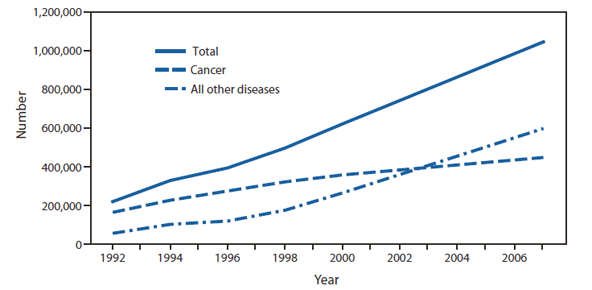
QuickStats: Annual Number of Patients Discharged from Hospice Care, by Primary Diagnosis (Cancer Versus All Other Diseases)* --- United States, National Home and Hospice Care Survey, 1992--2007

Logo of the Centers for Disease Control and Pr...Image via Wikipedia

Morbidity and Mortality Weekly Report (MMWR)


The figure shows the annual number of patients discharged from hospice care, by primary diagnosis (cancer versus all other diseases) in the United States during 1992-2007. Use of hospice care increased from approximately 219,300 discharged hospice-care patients in 1992 to 1,045,100 in 2007. In 1992, three out of four patients (approximately 163,600) had a primary diagnosis of cancer, compared with 55,500 patients with all other diseases. In 2007, less than half of patients (42%) had a primary diagnosis of cancer, for a total of 447,600 cancer patients, compared with 597,500 patients with all other diseases.
* Primary diagnosis is assessed on admission for hospice-care services. Estimates are based on the number of discharged patients, the majority of whom leave hospice care at death. Some patients might discontinue care while living, some might reenter care, and some might have more than one episode of care in a 12-month period.

The figure above shows the annual number of patients discharged from hospice care, by primary diagnosis (cancer versus all other diseases) in the United States during 1992-2007. Use of hospice care increased from approximately 219,300 discharged hospice-care patients in 1992 to 1,045,100 in 2007. In 1992, three out of four patients (approximately 163,600) had a primary diagnosis of cancer, compared with 55,500 patients with all other diseases. In 2007, less than half of patients (42%) had a primary diagnosis of cancer, for a total of 447,600 cancer patients, compared with 597,500 patients with all other diseases.

Source: CDC. National Home and Hospice Care Survey data, 1992, 1994, 1996, 1998, 2000, 2002, 2004, and 2007. Additional information available at http://www.cdc.gov/nchs/nhhcs.htm.

QuickStats: Annual Number of Patients Discharged from Hospice Care, by Primary Diagnosis (Cancer Versus All Other Diseases)* --- United States, National Home and Hospice Care Survey, 1992--2007
Enhanced by Zemanta

Friday, February 11, 2011

You're Sick. It's Serious.

The American Academy of Hospice and Palliative Medicine has just released a new video called "You're Sick. It's Serious."

Friday, February 4, 2011

Profit Status of Hospice May Mold Patient Census from MedPage Today

By Todd Neale, Staff Writer, MedPage Today

For-profit hospice agencies -- which have been increasing in number in recent years -- are more likely to enroll patients with dementia and noncancer diagnoses who require less care than nonprofit hospices, researchers found.
Full Article
Enhanced by Zemanta

Tuesday, January 11, 2011

TIME GOES BY | GRAY MATTERS: Lise's Tribute to Her Father, Saul Friedman

Posted by Ronni Bennett in the Time Goes By blog

As you know, Gray Matters and Reflections columnist, Saul Friedman, died on 24 December 2010. He was beloved by his readers, a great man, a great journalist and teacher, someone we could all do well to emulate.

Saul's funeral was held on Tuesday, 28 December, and his family has made some some of the orations, tributes, remembrances and eulogies available to Time Goes By. Over the coming Saturdays, they will be published here in place of his column.

This is from one of his daughters, Lise Friedman Spiegel. Married for 25 years with three children, she is a licensed clinical psychologist where she lives in Encino, California

- Ronni


After Mom informed Dad’s oncologist that Dad had taken a sudden turn for the worse and had but days left, the doctor said he had never seen a case like Dad’s in all his years. No kidding.

No one has seen a case like this and I am not necessarily referring to his cancer. Personally, I keep waiting for Dad to call while he is out chasing down a story.

Many of you know the writer, the speaker, the reporter, the blogger and, of course, the sailor. But, I must express to you what this larger-than-life man, who was NEVER supposed to die, gave me.

There is not enough time for all of those things, but here are some highlights.

First of all, the love for just about anything with four legs, especially dogs. I have never known my father without a dog at his side, on the bed, at the computer, awaiting a treat under the table. Puppies born at the beach in Nags Head and naming a new mutt who we had for 16 years Ringo in 1964.

Dad knew that one of the most moving gifts he gave me a few years ago was a one-month supply of skin medicine ($200) for my debilitated rescued Akita.

It’s no accident that we have four family dogs one of which Mom and Dad had flown first class to California when they could not keep her.

Then, there are the Beatles. Dad came home one day in 1964, when I was six years old and said, “I think these kids are something special. Listen.” You know the rest.

And when Paul McCartney married Heather just a few years ago, Dad called me with condolences.

And when I was a little girl and he thought I was ready to understand it, he took me to a movie theater to see Gone With the Wind. Well, no one since has looked up a staircase like Clark Gable did and that one of my daughters is named Melanie is no accident. It is still my husband’s and my favorite film of all time.

Then there is the love of music, all kinds of music - classical, good rock, folk, bluegrass. We went to concerts and bluegrass festivals and, of course, Dad’s love for singing and playing the guitar shaped so much of my future.

He came to my concerts and recitals and paced because he wanted so much for them to go well. A friend of mine sent me an email yesterday which recalled his tears of pride as I performed solo in Carnegie Recital Hall because she watched him as he listened between bouts of pacing.

And all the while, Dad made sure [my sister] Leslie and I remained aware of the world around us, reading the newspaper, socially conscious and willing to make sacrifices to follow our beliefs.

What other father would make sure their child missed much of 6th grade to work at the Vietnam Moratorium Committee and demonstrate against the war in October and November 1969?

What other father would get a long-term press pass to make sure I could sit in the gallery every day during the Watergate hearings?

And what other father would make sure I was sitting behind Ted Kennedy at the Democratic convention in 1980 when he made one of his finest speeches?

And how many kids can say that they met presidents, went to White House Christmas parties and correspondents’ dinners? I know the answer.

A few stories:

In 1972, Dad took me out of school to hang out with him for the last two weeks of the Nixon-McGovern presidential race. I traveled all over Michigan and some of Canada, for fun, ending up in the Detroit Free Press newsroom to await election results.

It was such a sad time, but a time that I had with him as he worked and taught me how the election process worked and why the obvious man should win. And I was so proud when Nixon put Dad on the infamous White House enemies list which, appropriately, took up residence on our bathroom door.

I was celebrating my 16th birthday and Dad wanted to take me out, just the two of us, to a fine French restaurant in Gerogetown, Lion d’Or. He bought me a dress and shoes and we went.

He said I could order any drink I wanted so, like a big girl, I ordered a scotch on the rocks. At the next table was a senator who Dad went out of his way to introduce me to. I do not remember what I ate, but I so remember how that whole evening made me feel.

Then, at the beginning of 10th grade, he and Mom took me out of school to travel in England, Scotland and Wales for two months because he thought traveling was a better education than sitting in a classroom. I learned British history, a love of horse riding on the Scottish moors and that schooling shouldn’t interfere with one’s education.

Finally, as Dad coped with the effects of his stroke, his esophageal cancer and this last cancer, he showed everyone that each day can be valuable and productive if one has love, especially in the form of my mother, sister and brother-in-law, resilience and an open mind to change which, for a man in his 70s into 80s, was extraordinary.

He showed the African bush to his family for his 80th birthday and just notice the car he and Mom bought last July and drove to New York together six weeks ago.
But that is just what he was and will remain for me: simply extraordinary, full of love, life and adventure no matter what came his way.


TIME GOES BY | GRAY MATTERS: Lise's Tribute to Her Father, Saul Friedman

(A number of Saul Friedman's articles have been posted by Aging and Disability in America
-- Jim)


Enhanced by Zemanta

Monday, January 10, 2011

End-of-Life Planning Common in Long-Term Care

By Crystal Phend, Senior Staff Writer, MedPage Today

Advance directives are common among long-term care residents, particularly those discharged from hospice, a CDC report found.

There was an advance directive on record for 28% of home healthcare patients, 65% of those at nursing homes, and 88% of hospice patients, according to an analysis of data from the 2004 National Nursing Home Survey and the 2007 National Home and Hospice Care Survey.

These rates compare very favorably with the 5% to 15% rate among adults overall in the U.S., Adrienne L. Jones, and colleagues at the CDC's National Center for Health Statistics in Hyattsville, Md., noted in the report.

But, they wrote, there's still room for improvement.

The most common forms of advance directives noted in the surveys were living wills and do-not-resuscitate orders.

The likelihood of having any type of advance directive appeared to differ by age and race or ethnicity.

Full Article
Enhanced by Zemanta

Thursday, January 6, 2011

Making the Most of Washington’s Change of Mind on End-of-Life Planning

excerpt from Transcend Hospice Marketing Group blog
Donald Schumacher, president and CEO of the National Hospice and Palliative Care Organization, said, “By having Medicare cover these voluntary consultations, beneficiaries will be able to get information that will help them make their own decisions about their care and what they would or would not want at life’s end.”

While we may not have predicted a change of mind regarding the end-of-life planning provision in Medicare legislation, this recent turn of events underscores the vital importance of hospices teaching their local communities the truth about the benefits of hospice care. While Medicare may not be facilitating advance care planning, there’s nothing stopping hospice organizations from stepping to the plate and engaging their local communities in conversations about options for care and support and the end of life. Go take advantage of the opportunity!
Transcend Hospice Marketing - Making the Most of Washington’s Change of Mind on End-of-Life Planning
Enhanced by Zemanta

Wednesday, January 5, 2011

A Reversal on End-of-Life Planning Under Medicare - NYTimes.com

Centers for Medicare and Medicaid Services - M...Image via Wikipedia
By ROBERT PEAR

The Obama administration, reversing course, will revise a Medicare regulation to delete references to end-of-life planning as part of the annual physical examinations covered under the new health care law, administration officials said Tuesday.

The move is an abrupt shift, coming just days after the new policy took effect on Jan. 1.

Many doctors and providers of hospice care had praised the regulation, which listed “advance care planning” as one of the services that could be offered in the “annual wellness visit” for Medicare beneficiaries.

Full Article
Enhanced by Zemanta

Letters to the Editor Responses to Really Old Age - There’s No Denying It - NYTimes.com

Image representing New York Times as depicted ...Image via CrunchBase
“Real Life Among the Old Old,” by Susan Jacoby (Op-Ed, Dec. 31) The New York Times received  a number of letters to the editor in response to the Op-ED.
The Letters
Enhanced by Zemanta

Saturday, September 4, 2010

TIME GOES BY | GRAY MATTERS: Of Death Panels and Palliative Care

by Saul Friedman (bio) writes the weekly Gray Matters column which appears in the Time Goes By blog each Saturday. Links to past Gray Matters columns can be found here. Saul's Reflections column, in which he comments on news, politics and social issues from his perspective as one of the younger members of the greatest generation, also appears at Time Goes By twice each month.

I assume you recall the summer of the “death panels.” That was last year when a few right-wing demagogues led by Sara Palin (who else?) warned that the health care reforms under debate would lead to deaths of patients whom doctors considered too old or ill to treat. Now we know they probably helped hasten the deaths of the desperately ill.

Here’s the background. In August, 2009, with the help of unthinking journalism and, naturally, the Fox loudmouths, Glenn Beck and Rush Limbaugh, the phrase “death panels” set off a fury of raucous town meetings with organized right-wing plants stirring up the mob, bringing confused innocents along with them on a tide of anger.

Few would listen to or even allow speakers, members of Congress, to explain the issue and call the lies for what they were. Even veteran Senator Charles Grassley, R-Iowa, who helped write the reform bill (he voted against), told a crowd that there was a genuine fear that “Granny” would die at the hands of a death panel. He regretted that stupidity, but the damage was done.

The section of the reform legislation that caused the furor, which was introduced by a Republican, was optional and totally benign. It merely authorized Medicare (and insurance companies) to pay physicians for their services if, during a period of five years, they are asked to and provide counsel to patients on alternatives to treatment, including hospice or palliative care.

Republicans and assorted right-wingers who did not support any health care reform cried “euthanasia.”
Cowed and frightened by the furor, President Obama and Democratic sponsors of the health reforms deleted the section. There have been sad consequences. Those fear mongers who raised the false alarm of “death panels” may have been responsible for the early deaths of terminally ill patients, who could have lived longer and more comfortably, free of pain, with hospice or palliative care.

That is one of the conclusions of a study in the August 18 New England Journal of Medicine on the value of palliative care for terminally ill patients. As The New York Times reported,
“[D]octors have found that patients with terminal lung cancer who began receiving palliative care immediately upon diagnosis not only were happier and in less pain as the end neared – but they lived nearly three months longer...The findings...confirmed what palliative care specialists had long suspected. The study also, experts said, cast doubt on the decision to strike end-of-life provisions from the health care overhaul passed last year.”
Palliative care, which is optional for the patient, means forgoing curative treatment such as surgery, radiation or chemotherapy any of which may be more painful or debilitating than the disease.

A physician, whose office visits, exams and treatments are partly covered by Medicare, may also advise a patient (for no extra fee) on the possibility of palliative care. If the doctor states that the patient has less than six months to live, the palliative care (which may include pain-killing drugs, physical examinations, and even chemotherapy that is not meant to cure) is usually provided by a hospice organization whose services are fully covered by Medicare.

And, as I’ve written, hospice care won’t end if the patient lives beyond those six months. It’s called “open access.”

Indeed (a personal acknowledgment), I have been on ‘open access” palliative care, with the help of the Hospice of the Chesapeake, for more than six months because the cancer I’m fighting seems not to be growing. I live with uncertainty, but I have the comfort of knowing the hospice professionals are there to help if things change.

Dr. Diane E. Meier, director of Mount Sinai School of Medicine’s Center to Advance Palliative Care told the Times, the study
“...shows that palliative care is the opposite of all that rhetoric about ‘death panels.’ It’s not about killing Granny; it’s about keeping Granny alive as long as possible – with the best quality of life.”
Dr. Atul Gawande, a Harvard Medical School surgeon who has written long articles on medical care for the New Yorker, called the results of the study “amazing.” His latest article, Letting Go – What Should Medicine Do When it Can’t Save Your Life, recounts the long suffering of patients who chose to fight cancer with radiation, surgery or poisonous chemotherapy before their deaths.

As the Times reported, while the study could not determine why the patients lived longer, experts pointed out that depression and constant pain deprived patients of sleep, and chemotherapy means th loss of appetite, nausea, hair loss and other debilitating side effects.

Dr. Sean Morrison, president of the American Academy of Hospice and Palliative Medicine, told the Times that the study was the
“...first concrete evidence of what a lot of us have seen in our practices – when you control pain and other symptoms, people not only feel better, they live longer.”
Of course, depending on the diagnosis and prognosis, some people opt for any treatment no matter how painful to fight their disease. But there is no way of knowing how many people have been denied access to hospice and the comforts of palliative care for their terminal or extended illness, which may not be cancer. And there is no way of knowing how many people were denied a longer, better quality of life.

But my hospice social worker pointed out that many doctors are more inclined to treat illnesses and try for a cure than suggesting palliative care. That’s part of their training. End-of-life counseling and palliative care are fairly new developments in dealing with illness.

If my case is an indication of the process, my oncologist did not know how my cancer was progressing, but he told me that some chemotherapy could not cure it or get rid of it, but may curb its growth. That meant palliative, non-curative care. I could have opted for more aggressive treatment. But I was admitted to hospice, which has cared for me ever since, sparing me from having to go to emergency rooms for small problems. As luck would have it, something, perhaps the chemo, stopped the progress of the cancer – for now.

I’m not accusing doctors of being greedy but under our system, the vast medical industrial establishment of physicians, specialists, hospitals and labs get paid more by Medicare and insurance companies for the expensive efforts to cure, which may include CT scans, MRIs, blood tests, radiation, chemotherapy and surgery. And they have great investments in buildings and technology to pay for.

In addition, there is a natural conflict between palliative care specialists and oncologists and surgeons who are battling cancer and see palliative care as “giving up.”

Because of the “death panels” furor, doctors won’t get paid (the fees would have been relatively small) to counsel on end-of-life decisions for Medicare patients. But with that section no longer part of the health reforms, privately insured patients in their fifties who have spreading cancers or other terminal illnesses will have difficulty getting covered for getting access to information about palliative care and hospice unless the physician volunteers it.

A note to Sarah Palin, et al: your death panels rants have probably denied at least some Grannies of a longer, more comfortable life.

Write saulfriedman@comcast.net
TIME GOES BY | GRAY MATTERS: Of Death Panels and Palliative Care
Enhanced by Zemanta

Tuesday, August 31, 2010

Evaluating Employee Turnover in Home and Hospice Care

by Richard Shank

The number of home and community based services for older adults have grown tremendously over the past 20 years. This has occurred because of a continued shift in government expenditure related to these programs and an increasing desire of older adults to age in place in their homes and/or communities. Because of this growth, it is no surprise that questions about staffing quality and professionalization are now occurring related to home-based care. In response, a new study has compared the turnover rates of home care and hospice agencies among their direct care staff.

This study found that both organizational characteristics and factors related to the local economy often drive turnover in home and hospice care. The findings suggest that focusing on these organizational characteristics will improve retention and care quality. This study also provides direct care turnover rates for care providers in North Carolina.
Continue Reading
Enhanced by Zemanta

Tuesday, August 24, 2010

Personal Health - New York Law Encourages Frank Talk on Palliative Care - NYTimes.com

Image representing New York Times as depicted ...Image via CrunchBaseby Jane Brody

Legislators have begun to recognize the medical, humanitarian and economic value of helping terminally ill patients and their families navigate treatment options as they approach the end of life.

Last week, over the objections of New York State’s medical society, Gov. David A. Paterson signed into law a bill — the New York Palliative Care Information Act — requiring physicians who treat patients with a terminal illness or condition to offer them or their representatives information about prognosis and options for end-of-life care, including aggressive pain management and hospice care as well as the possibilities for further life-sustaining treatment.
Continue Reading
Enhanced by Zemanta

Sunday, July 11, 2010

Medicare policy may account for growing length of hospice stays in nursing homes

ScienceDaily (July 9, 2010) — Researchers at Brown University have found that the length of an average Medicare-certified hospice stay in a nursing home has doubled during the last 10 years.

The study, which will appear in the August issue of The Journal of the American Geriatrics Society, evaluated hospice use in U.S. nursing homes between 1999 and 2006. It found the typical treatment time has increased from 46 to 93 days. The researchers cited a standard daily payment rate for most Medicare hospice enrollment days as an incentive for some of the longer stays.

The study also found that the doubling of Medicare services in nursing homes is associated with a 50-percent growth in the number of hospices, primarily for-profit hospices. Currently, one-third of Medicare beneficiaries who die in nursing homes are accessing hospice services, and the study predicts that this number will increase.
Read Article
Enhanced by Zemanta

Saturday, June 26, 2010

GRAY MATTERS: Assisted Death

by Saul Friedman (bio)

 The poet Dylan Thomas said it best for those of us of advanced age: “Do not go gentle into that good night; rage, rage against the dying of the light.” But what if there is no good alternative to quietly turning out your light?

In Connecticut, the home state of insurance giants, a legal and moral battle rages that may have national implications as two physicians have sued the state for an action that could eventually allow patients to choose a peaceful, drug-induced death to avoid the pain and terrors of a terminal illness.
As CNN's Randy Kaye reported,
“While courts have addressed constitutional questions connected with aid in dying, no court has directly considered whether a mentally competent, terminally ill patient’s desire to bring about a peaceful death should be considered a ‘suicide.’”
That’s vital, for a suicide is generally against the law and the family of the person who dies may suffer spiritually and legally, including the loss of insurance and other claims.
 
Thus, Connecticut physicians Dr. Gary Blick and Ron Levine are suing the state, asking that the state’s laws restricting assisted suicides should not include cases in which mentally competent, terminally ill patients take their own lives to avoid pain and suffering.

The suit, which a superior court judge has dismissed on technical grounds, was prompted in part by several cases in which people have been punished for helping friends or relatives to die. Right to die advocacy groups are expected to appeal.

In the most publicized case, in 2004, John Welles, who was dying of cancer and suffering, pleaded with a friend, Hunt Williams, to give him a pistol. Williams did as his friend asked. As Welles walked away in the woods, Williams shouted “God bless” and heard the gunshot. Welles died and Williams was convicted of “assisting a suicide,” a felony in the state.

Blick’s suit was aimed, in part, to clear and free Williams and win permission to end a dying patient’s suffering. Said Blick,
“We’re not talking about hooking up a potassium chloride drip and have our patient’s heart stopped. We’re talking about terminally ill patients who I’ve counseled over the years and that I would like to give them prescriptions and help them die with dignity.”
Blick, the Medical and Research Director of CIRCLE Medical, is a specialist in infectious diseases and HIV-AIDS, which raised for me a question. Not a few years ago, AIDS was considered always fatal. Now it’s not. How many AIDS patients took their lives, rather than wait for the life-saving treatments now available?

Nevertheless, if Blick and Levine are successful in their campaign, Connecticut could join a growing number of states that recognize the right of a terminally ill patient to end his/her life with the help of a physician.

The recent HBO film, You Don’t Know Jack, was a sympathetic portrait of Jack Kevorkian who was jailed for helping a number of people die, most them not his patients. But he brought the issue to a life that is growing. Recent polls indicate that 60 percent of whites (38 percent of blacks) favor allowing physicians to assist the terminally ill to die.

By all accounts, Oregon’s pioneering “Death With Dignity” law has been doing what was intended. The 1998 law (which has been copied in Washington state) has survived legal challenges including protests by members of Congress because of its safeguards. A physician must determine that the patient has less than six months. and a second opinion is required. The patient must make repeated requests, waiting at least 15 days between requests.

If these procedures are followed, an Oregon physician can prescribe the life-ending drugs, which may be taken with or without a doctor present. In this way about 30 persons a year have gone through the process and died, usually with close family members present. Most of the patients were suffering from advanced cancer or ALS (Lou Gehrig’s Disease).

Leading medical institutions, Harvard Medical School and organizations such as the American Medical Women’s Association, the American Medical Student Association and the American Public Health Association support legislation permitting physicians to assist terminally ill patients to take their lives with drugs.

The American Medical Association stands opposed. And the American Academy of Hospice and Palliative Medicine is neutral, possibly because proper hospice care (in which I am now a participant) can avoid the need to take one’s life and even put off death.

But in the end, hospice provides for pain free and comfortable last days with the help of a hospice nurse to tend to the patient and a hospice social worker to work with the family.

Much of the opposition to assisted death also comes from the severely disabled and persons with serious chronic diseases. They fear, with some justice, that they and people like them will be vulnerable if, for example, their insurance companies balk at the cost of their care. Remember former Colorado governor Richard Lamm telling such people to “get out of the way” because they were costing Medicare too much money?

Other opposition comes from religious institutions and right-to-life organizations who also oppose elective abortions. I disagree, of course, but I believe that just as the state should stay out of a woman’s right to choose, so the state should not need to come between a dying patient and his/her right to choose the manner and time of his/her death.

Oregon’s statute, I admit, is a model of regulation for the safety of the patient’s rights and to guard against abuse - say by relatives who can no longer care for the patient. But the choice of hospice seems to be minimized. That’s why I’m uncomfortable with such organizations like Compassion and Choices, which seems to advocate an end-to-life as if it were a walk in the park.

They may encourage people to seek the alleged comfort of death for no good reason. A woman I know whose medical problems are serious but not life threatening seems to have given up on life because she’s despondent over the death of her husband.

End-of-life advocates seem to provide little encouragement to fight a disease, as I am, and the reasons for their despondency, the better to hang onto life and “rage against the dying of the light.”

As another, more gentle poet, Robert Frost. has written, “The woods are lovely, dark and deep. But I have promises to keep and miles to go before I sleep. Miles to go before I sleep.”

Write saulfriedman@comcast.net

http://www.timegoesby.net/weblog/2010/06/gray-matters-assisted-death.html

Enhanced by Zemanta

Sunday, May 23, 2010

TIME GOES BY | GRAY MATTERS: Hospice

by Pulitzer Prize-winning journalist Saul Friedman

My cancer doctor told me in writing, that I had six months to live. But he acknowledged he could not be sure and that the six months could be extended indefinitely.

That made me eligible to take advantage of a little understood, free Medicare program that has been enhanced by the new health insurance reforms, and could be available to anyone with a prolonged, chronic, life-threatening illness. I’m talking about the Medicare/Medicaid hospice program.

Until recently, entering a hospice program was frightening because it meant you understood you were dying and you voluntarily agreed to forgo chemotherapy or any other curative treatment, and were given only palliatives, painkillers and bedside help from professional whose job it was to make you comfortable.

All that has changed. As Dylan Thomas told us, we should “not go gentle into that good night.” So hospice should no longer be feared and avoided like the “dying of the light.” Rather, it should be embraced as a fine, comprehensive, home health care program.

A little background: In 1995, Medicare was under assault from the Republican Congress led by Newt Gingrich. Specifically, Medicare’s funds were cut to pay for private Medicare HMOs. And Medicare was criticized for the amount of money it was spending on the care of beneficiaries in the last year of their lives. Indeed, it accounted for a third of Medicare spending.

Medicare responded with its pioneer hospice program to care for the dying. Hundreds of hospices were founded around the country, most of them funded by Medicare which included nurses, social workers and devoted volunteers who became the providers of palliative care for the dying.

Private insurers followed with coverage of hospice services, but private insurance carried heavy premiums; Medicare covered 100 percent of hospice costs.

I watched how it worked for a close relative who was dying of lung cancer and his family. Hospice supplied the hospital bed set up in the home. Hospice supplied the drugs he needed for pain as well as the care to keep him clean and comfortable. And hospice helped with bereavement counseling for his wife and son.

Then, as now, he was admitted to hospice because his doctor attested that he had less than six months to live. He died three months after his diagnosis. But remember the columnist Art Buchwald who cheated death and remained in hospice care for much longer than six months?

Because such predictions are more and more uncertain as treatment options have become available, the courts forced a change in Medicare regulations. A person could not be discharged from hospice because he lived longer than six months; the six months could be renewed indefinitely.

Since 2007, Congress and Medicare have realized that with medical advances such as the CT-Scan, PET-Scan, open heart and by-pass surgery, radiation and chemotherapy, Medicare could not insist that hospice patients cannot take advantage of these possibilities while fighting his or her disease. Medicare and private insurers adopted an “open access” policy, admitting into hospice – for curative and/or palliative treatment, as long as a doctor said they had no more than six months to live.

Thus hospice has become a comprehensive health care program for the seriously ill, who may or may not be close to death. Indeed, as I have learned, it is not at all rare that a beneficiary can get well enough to graduate from hospice. My hospice expects me to be one of those beneficiaries.

In the meantime, hospice assigns to a beneficiary a nurse who comes by your home regularly to check your vital signs, see how you’re doing and help with chronic or even acute medical problems. Even more important, the assigned nurse or another nurse is on call 24/7. That means that if there is an emergency, such as a urinary problems, or the side effects of the chemotherapy, you need not go to the emergency room.

I’ve learned that the hospice nurse on call is equipped and trained to deal with such problems. No longer do I need to call 911 on a weekend and go to an emergency room. Besides being traumatic and tiring, it would cost Medicare hundreds, even thousands of dollars.

Similarly, while a hospice beneficiary may keep routine appointments with doctors, hospice nurses are equipped to deal with colds, the flu and other ailments that would ordinarily send you to a physician at Medicare’ expense. And hospice will help a patient’s oncologist by drawing blood often to keep track of possible problems such as a drop in the red or white cell counts or potassium and iron levels.

Thus hospice becomes your caregiver in fighting the disease as well as preparing for the worst. Medicare hospice, for example, supplies beneficiaries with kits that include morphine and other powerful painkillers; I’ve put my kit away and have almost forgotten about it. The best option is to avoid hospitalization for your illness for Medicare requires that hospital patients forgo curative treatment.

In addition, Medicare hospice assigns to beneficiaries a licensed, professional social worker to help family caregivers with advice, counseling and resources to help patients and families cope with the stresses of life-threatening and debilitating illness. Hospice may supply a hospital-style bed with linens or oxygen, or an IV to prevent dehydration.

The recently passed health reforms expanded curative and palliative hospice care for children in Medicaid or the Children’s Health Insurance Program (CHIP). It allows children enrolled in either program to receive hospice services without forgoing curative treatment. The Centers for Medicare and Medicaid Services (CMS) are expected to require states to comply with the changes, which are to take effect in 2013.

Finally, as of next January 1, the reforms will require that a nurse practitioner or doctor must have a face-to-face encounter with the patient at the end of the six month period to recertify his/her eligibility.

You can read or download and print [pdf] Medicare’s 16-page booklet on its hospice services, including where to find a hospice near you.

Write to saulfriedman@comcast.net

TIME GOES BY | GRAY MATTERS: Hospice
Reblog this post [with Zemanta]

Thursday, March 18, 2010

Study Suggests Doctors Overlook Effects Of Implanted Heart Defibrillators In Dying Patients

{{de|1=Satellitenschüssel vor der Zentrale des...Image via Wikipedia

(Medical News Today) The Associated Press reports that heart defibrillators implanted in a patient's chest may disrupt a quiet death, but doctors and relatives of people dying of non-heart related diseases often don't consider that issue. "It's not unusual for health professionals to avoid the topic, says Dr. Nathan Goldstein of New York's Mount Sinai Medical Center. His research, published this month in Annals of Internal Medicine, suggests most hospices - expert in end-of-life care - aren't making defibrillator decisions part of their routine." The devices can cause "painful, repeated shocks" in some patients if they are not turned-off. "Nearly 60 percent of hospices he examined had at least one patient shocked within the past year, sometimes multiple times at once. Yet just one in 20 hospices had a method even to identify who harbored the implant when they entered the program. But with more than 100,000 implantable cardioverter-defibrillators, or ICDs, inserted every year, more and more families ... will face the question" (Neergaard, 3/15).
Continue Reading
Reblog this post [with Zemanta]

Thursday, February 18, 2010

Why Are Fewer Patients Enrolling in Hospice? - Kaiser Health News

by Howard Gleckman, Senior Research Associate at the Urban Institute

Suddenly, many hospices are admitting fewer patients. Others are increasingly caring for people for just days or hours before they die. The result: cash-strapped hospices are cutting back on nurses and aides, and patients are missing out on critical end-of-life care.

It is not clear why it’s happening, but some hospice officials blame both a bad economy and Medicare rules that unintentionally discourage doctors from referring all but those who are about to die.

Continue Reading
Reblog this post [with Zemanta]

Monday, January 25, 2010

Doctors Delay Talking About End-Of-Life Care - Kaiser Health News

from Kaiser Health News

A study published this month finds doctors delay talking about end-of-life care, which often proves very costly. The Los Angeles Times reports: "Most doctors don't talk about end-of-life issues with their cancer patients when those patients are feeling well, a new survey has found." Physicians also tended to delay these conversations "until treatments have been exhausted. Those delays mean patients might not be able to make truly informed choices early in their treatment. The study, published online Jan. 11 in the journal Cancer, surveyed 4,188 physicians about how they would talk to a hypothetical cancer patient with four to six months to live. A majority of respondents (65%) said they would discuss prognosis, but only a minority said they would discuss do-not-resuscitate status (44%), hospice (26%) or preferred site of death (21%) at that time. Rather, they would wait until symptoms were present or until there were no more treatments to offer" (Adams, 1/25).

Read More

Sunday, January 24, 2010

The insurance doctor: Immigrant shunned medicine, but comforted by Medicare | coloradoan.com | The Coloradoan

A Medicare card, with several areas of the car...Image via Wikipedia

by By Peter Trozan

At 65 she enrolled in Medicare but only saw a doctor once during the next 25 years. At age 91, Jenny fell and broke her clavicle and severely injured her lower back and hip.

When she left the hospital, Jenny moved into my house, and together with my wife’s help, we took care of her 24/7. You see, Jenny, is my mother.

Although she experienced excruciating pain and would scream out when being moved, she adamantly refused pain medications. After five months she healed sufficiently to return to her own home. Last week Jenny fell again, this time fracturing her hip. Once again, she moved in with us, again refusing all prescription meds.

Because she used natural remedies, her medical expenses have been virtually non-existent. Nonetheless, it has been a great help and comfort having Medicare for those unforeseen accidents. Without a doubt, my mother is a rare individual, but even she has benefited from the medical support provided by our community:

> A pendant worn around her neck to call for help in an emergency (our own expense).

> Ambulance and paramedics (Medicare pays 80 percent).

> Emergency room and CT scans (Medicare pays 80 percent).

> Homecare services provided by the staff at Columbine. Since home care is far cheaper than having someone institutionalized, Medicare pays 100 percent for home care rather than the usual 80 percent.

> Hospice care for about 6 months a few years ago. This is supposed to be for terminally ill patients and is covered by Medicare at 100 percent. Jenny beat the odds and confounded the experts as she “graduated” out of Hospice.

Read More
Reblog this post [with Zemanta]

Wednesday, December 23, 2009

Home Care Law Blog: Update on Health Care Reform and Home Health - The Ghost of Christmas Future

NAHC has sent out an update to its members on the effects to home health and hospice of the Manager's Amendment that is currently working its way through the Senate. LIke the Ghost of Christmas Future in A Christmas Carol, it paints a pretty bleak picture. (I apologize for the Christmas Carol references, but I thought I would try to distract from the bad news with a Christmas theme.) According to NAHC, the Manager's Amendment will do the following:

Specifically, the amendment makes the following changes to the home health portions of the overall health reform package:
Read More