Showing posts with label technology. Show all posts

Wednesday, March 9, 2011

JFActivist: Transportation: Will Technology Innovations Benefit People with Disabilities?

By Jenifer Simpson, AAPD Policy

On February 23, 2011, AAPD was invited to attend a workshop on “Technological Innovations in Transportation for People with Disabilities” held by the Federal Highway Administration in McLean, VA. The event was convened by Mohammed Yousuf in the Office of Operations Research & Development at the agency, as part of their Exploratory Advanced Research (EAR) program. The EAR program is examining how current and future advancements in intelligent transportation systems and other technologies could improve accessible transportation for people with vision disabilities and for people with other disabilities. The aim would be both to advance safety and promote greater independence.

While connection of vehicles through wireless networks is a current focus for intelligent transportation – for the purpose of more efficient use of vehicles and the goods they transport – pedestrians can also benefit from technology advances. Research on vehicle-highway interaction, nanotechnology, and a host of other types of transportation research in safety, pavement design, highway structures and bridges, human-centered systems, operations and intelligent transportation systems, and in materials science can all offer new ways to provide accessibility for people with disabilities.
 
The workshop included presentations on advances in wireless technology, computer vision, artificial intelligence and robotics. Discussion focused on how these new technologies could be integrated to assist people with disabilities to be more mobile and independent. For instance, wayfinding, navigation, orientation and guidance for people with vision disabilities could be enhanced by more wireless connections and better databases of information about the built environment. Similarly, people with intellectual disabilities might benefit from devices that provide directions and guidance. A key component to new tools for accessibility by people with disabilities is greater availability of sensor devices that can be attached to objects in the environment, such as lamp posts, traffic signs, building entrances, vehicles etc.

Saturday, February 12, 2011

FDA Okays First 3-D Mammogram Device

Logo of the U.S. Food and Drug Administration ...Image via Wikipedia
By Cole Petrochko, Staff Writer, MedPage Today

The FDA has approved the first x-ray mammography device that provides 3-D images of the breast.

Approval of the Selenia Dimensions System was based on two studies asking radiologists to review 2-D and/or 3-D images from over 300 mammographies. Radiologists who viewed the 2-D and 3-D models were 7% more accurate in distinguishing cancerous and noncancerous cases than those who only used a 2-D image, an FDA statement said.
Full Article
Enhanced by Zemanta

Friday, February 11, 2011

The Republic - A Look at the World Over 50

centreImage via Wikipedia
By Jane Glenn Haas The Orange County Register

We know baby boomers are turning 65 at the rate of one every seven seconds, but what about the 50-year-olds?

The millions turning 50 will reshape the "active aging" market to meet their own needs and desires, says Colin Milner, CEO of the International Council of Active Aging, based in Vancouver, B.C.

Full Article
Enhanced by Zemanta

Saturday, January 29, 2011

The Accessibility Features of the iPad - Disability.gov

By Guest Blogger Amanda Johansson, Testfreaks.com

Today, computers have infiltrated almost all aspects of modern life, and they serve as great tools in those activities. On the heels of desktops and laptops are electronic tablets, and they are now being accepted en masse in our everyday lives. In fact, the most popular tablet to date, the iPad, has been sold by millions to people across all walks of life.

But to someone with special needs, using a tablet might be difficult. Luckily, like most modern computers, the iPad has accessibility features built into the device, and such features may prove to be handy for a wide variety of users. Exactly what are these accessibility features? Let's take a look.
Full Article

Friday, January 21, 2011

Grandma's Vital Signs on Your Phone

by Eric Bogatin

Automated home health monitoring may finally become practical with the HealthTune 360 from Boston LifeLabs. Cambridge, Mass. start-up Boston LifeLabs recently announced a new product for at-home health monitoring, which the company plans to make available within a few weeks in the U.S. pending FDA approval.
Full Article
Enhanced by Zemanta

Wednesday, January 12, 2011

Teens Take Elders to Tech Boot Camp - WSJ.com

Teens can be motivational teachers for the elderly because of their enthusiasm for technology and agility with gadgetry. But, oh, the eye-rolling. These pair-ups can expose daunting cognitive and psychological gaps between generations, forcing young and old alike to adjust their attitudes.

A growing number of programs are training teens to work with seniors. The Central Oregon Council on Aging, a Redmond, Ore., senior-services agency, enrolled 70 people last year for tech training by teens from a nearby high school's computer class, and 100 more are signed up this year. A Carmel, Ind., nonprofit, Net Literacy, enlists 400 to 600 middle- and high-school students each year for a senior tech-training program called "Senior Connects." And at New York's Pace University, a popular service-learning program sends students to retirement facilities to teach seniors skills from email and online banking to Wii and video chat.

Full Article

Sunday, January 9, 2011

1 in 6 Caregivers Uses Mobile Technology -- AARP Technology

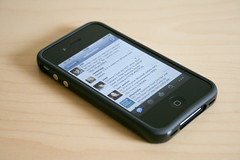
iPhone 4 - TwitterImage by William Hook via Flickr
by: AARP Technology

AARP released today an original survey titled, "Health and Caregiving among the 50+: Ownership, Use and Interest in Mobile Technology" that demonstrates that half of people 50 and over use — or are at least somewhat interested in using — mobile technology for their health. Among caregivers of people age 50 and over, one in six uses a mobile technology to track the health of their care recipient.

The majority of people 50 and over own some type of mobile technology and nearly eight out of 10 own a cell phone. Not surprisingly, cell phones are the most frequently mentioned mobile device that respondents say they take with them when they leave home.

While cell phones could be a productive means of communicating with this audience about health issues, respondents' receptivity varies by how the technology is to be used. However, there is substantial interest in using mobile technology to track one's own health.
Full Article
Enhanced by Zemanta

Saturday, January 8, 2011

HomeHealthcare Monitoring Technology Estimated to Be Worth $10 billion

Companies across the world are working to develop innovative solutions for the aging populations of Europe, the United States and Canada. Many of these products and services for baby boomers are designed to enable older adults to live independently during their golden years.

One new report conducted by the Swedish analyst firm Berg Insight has estimates that this emerging market is worth $10 billion in 2010. New devices that utilize wireless technology are also being created for this industry.

"Progress is being made in the adoption of wireless technology among manufacturers of medical monitoring equipment, but there is still a long way to go before remote monitoring becomes a standard practice in the healthcare sector," said senior analyst André Malm, according to HealthcareITNews.com.

He predicted that health-related apps will be released for smartphones in increasing numbers, making mobile health programs (mHealth) more accessible. "The number of apps focusing on chronic disease management is however still relatively low," he explained.

Full Article
Enhanced by Zemanta

Thursday, January 6, 2011

Military Technology Helps Wheelchairs Detect Hazardous Terrain | Wheelchair Accessibility Blog and Disability News

by Destiny

Researchers are working on developing a wheelchair that can detect hazardous terrain and self adjust its settings to move more smoothly and safely over different types of landscapes. The new technology helps electric wheelchair users avoid accidents involving wheels slipping, sinking, or tipping over.

The idea originated from automatic terrain-sensing controls for unmanned military vehicles and multiple four-wheel-drive automobiles that are already on the market. Emmanuel Collins from Florida State’s Center for Intelligent Systems stated that the device is known as a laser line striper and is used to recognize different terrain conditions.

Full Article
Enhanced by Zemanta

Thursday, August 26, 2010

NPR: Technology Can Help Seniors Stay In Homes

Headquarters of National Public Radio in Washi...Image via WikipediaNPR continued its series on seniors aging at home.

Part two examined a company called Adaptive Home, "one of a growing number of startups that use monitoring technology to revolutionize elder care. These companies are also betting on a big market as the baby boomers enter old age. Chris Bridgers says a basic package includes about a dozen motion sensors placed strategically around a house. They can provide adult children with a stunningly detailed rundown of a parent's day" (Ludden, 8/23).

Part three continued looking at "wired homes," with an example of a older couple in Georgia monitored via live video hookup to a company in Indiana. "The scene may not seem so strange in the era of Skype, when many people use the computer to keep in touch with far-flung relatives. But ['telegiver' Denise] Cady can see almost every move the Fitzgeralds make. Their house is wired with video cameras ... ResCare's services start at $600 a month and can run well over $1,000 depending on how much active monitoring is needed. But that's still a lot less than the average nursing home" (Ludden, 8/24).
Read Full Article
Enhanced by Zemanta

Wednesday, August 11, 2010

MIT diabetes device monitors glucose with light | Crave - CNET

The blue circle symbol used to represent diabetes.Image via Wikipedia
Imagine simply shining a light on your skin to determine how much sugar is in your blood. Researchers at MIT are developing a glucose-monitoring device for diabetes patients that may help do away with finger pricks.

By scanning a user's arm or finger with near-infrared light, the device frees users from the necessity of drawing blood, a daily routine for most type 1 diabetes patients.
Continue Reading
Enhanced by Zemanta

Friday, August 6, 2010

Accelerating Electronic Health Records Adoption and Meaningful Use

The emblem of Recovery.gov, the official site ...Image via Wikipedia
The following joint statement, by the National Coordinator for Health Information Technology, David Blumenthal, M.D.,M.P.P., and the Centers for Medicare & Medicaid Services' Principal Deputy Administrator Marilyn Tavenner, was issued today at a forum,"Accelerating Electronic Health Records Adoption and Meaningful Use."

The forum was sponsored by the Health Industry Forum at Brandeis University and Health Affairs:

"The goal of achieving widespread adoption and meaningful use of electronic health records by 2014 is established in the Health Information Technology for Economic and Clinical Health Act of 2009 (HITECH), part of the American recovery and Reinvestment Act of 2009.

The HITECH Act directs the Centers for Medicare & Medicaid Services(CMS) to administer an incentive payments program that will make available significant bonus payments to eligible health care providers who adopt and demonstrate meaningful use of certified electronic health records (EHR).  In addition, the HITECH Act provides for leadership and
support for EHR adoption and use through the Office of the National Coordinator for Health Information Technology (ONC). 

"On July 13, final regulations were announced by CMS and ONC that define the incentive payments program, the meaningful use requirements for Stage 1 of the program, and the standards and certification requirements for certified EHR systems.

"However, the CMS and ONC regulations establish only the parameters of the federal program.  The public and private sectors can and must collaborate in furthering the goal of creating a 21st century electronic health information system in the United States.

"For that reason we are pleased and encouraged by today's announcement of significant initial steps by organizations across the spectrum of health care to support HITECH's goal of furthering the meaningful use of certified EHRs.  These entities include providers, payers and professional licensure bodies.  The individual programs announced today show both an appreciation of the challenges we face as well as initiative and creativity in applying the resources of these organizations toward meeting our goals.  The actions announced today are also built on the meaningful use structure, which provides alignment of our national efforts toward coherent technology adoption and toward improved health and health care goals.
Enhanced by Zemanta

Wednesday, August 4, 2010

Being There, Without Leaving Home - The New Old Age Blog - NYTimes.com

Image representing New York Times as depicted ...Image via CrunchBase
by Paula Span

At the Selfhelp Benjamin Rosenthal Senior Center in Queens, a social worker, Rachel Itzkowitz, is leading the weekly current events class, guiding participants through a series of discussions. What did they think about that shooting at the Mexican border? About higher compensation for first responders injured on Sept. 11? And what about the controversy over building a Muslim community center near the World Trade Center site?

With backing from Microsoft and the city’s Department for the Aging, Selfhelp has created a “virtual senior center” for about a dozen low-income elderly people, with six more scheduled to join the party at the end of the summer.

Even with big touch-screen monitors and an easy-to-use interface (called It’s Never Too Late), it took twice-a-week training for a couple of months before the new users could manage the equipment. Most had never used a computer. One who’d never learned to type found the QWERTY keyboard confusing, so Microsoft substituted one with keys in alphabetical order. The group has taken advantage of adaptations like magnifiers and screen readers that read text aloud.

Bringing older people online proved to be, in other words, a labor-intensive undertaking. But Selfhelp’s vice president for senior communities, Leo Asen, is convinced that the benefits justify it.

Read More
Enhanced by Zemanta

Monitoring Elderly Parents - NYTimes.com

Image representing New York Times as depicted ...Image via CrunchBase
It used to be that parents kept tabs on their children. But The Times reports this morning on new technology making it possible for adult children to monitor, to a stunningly precise degree, the daily movements and habits of their aging parents.

The purpose is to provide enough supervision to make it possible for elderly people to stay in their homes rather than move to an assisted-living facility or nursing home, and in truth many of the systems are godsends for families. But, as with any parent-child relationship, all loving intentions can be tempered by issues of control, role-reversal, guilt and a little deception — enough loaded stuff to fill a psychology syllabus.
Read the Full Story
Enhanced by Zemanta

Wednesday, July 14, 2010

The “Meaningful Use” Regulation for Electronic Health Records | Health Care Reform Center

by David Blumenthal, M.D., M.P.P., and Marilyn Tavenner, R.N., M.H.A.

The widespread use of electronic health records (EHRs) in the United States is inevitable. EHRs will improve caregivers’ decisions and patients’ outcomes. Once patients experience the benefits of this technology, they will demand nothing less from their providers. Hundreds of thousands of physicians have already seen these benefits in their clinical practice.


But inevitability does not mean easy transition. We have years of professional agreement and bipartisan consensus regarding the potential value of EHRs. Yet we have not moved significantly to extend the availability of EHRs from a few large institutions to the smaller clinics and practices where most Americans receive their health care.


Last year, Congress and the Obama administration provided the health care community with a transformational opportunity to break through the barriers to progress. The Health Information Technology for Economic and Clinical Health Act (HITECH) authorized incentive payments through Medicare and Medicaid to clinicians and hospitals when they use EHRs privately and securely to achieve specified improvements in care delivery.

Continue Reading

National Progress Report on eHealth - The Commonwealth Fund

A new report from eHealth Initiative—an organization that seeks to help health care industry stakeholders better understand and use health information technology (IT)—tracks developments over the past three years in promoting the adoption and use of health IT. Supported by The Commonwealth Fund, the National Progress Report on eHealth finds that:
  • Significant advances have been made as a result of public and private sector initiatives. The 2009 American Recovery and Reinvestment Act, which allocated $30 billion to promote health IT, has been a key driver of progress.
  • Many providers are concerned about the lack of coordination across government health and health information technology initiatives.
  • More education and outreach to consumers about health IT and health information exchange are needed.
  • Knowledge and transparency of privacy and security policies will be key to building consumer trust.
More than a hundred experts helped assess progress in the following five areas: aligning incentives, engaging consumers, improving population health, managing privacy, security and confidentiality, and transforming care delivery. Stakeholders’ perceptions of progress were also gauged. Sixty-one percent agreed or strongly agreed that significant progress has been made in the successful adoption and use of health IT since 2007, but most (67%) felt that outreach to educate consumers about the value of electronic health records and health information exchanges is not effective.

To realize the goal of using health IT adoption to improve quality in care delivery, the report recommends implementing policies and programs that take into consideration all sectors of the health care community, including consumers, and promoting further education on the new privacy and security laws and regulations.

Read complete report

Thursday, June 24, 2010

Consumer Choice Technology Hearing

Tuesday, June 29, 2010  |  8 a.m. to 5:15 p.m.

Grand Hyatt Hotel
1000 H Street, N.W., Washington, DC 20001
Meeting Location: Constitution Ballroom, Constitution Level
 c
Held by the Privacy and Security Tiger Team, the meeting will be a discussion about technologies that enable consumers to choose whether or not to share their information in a health information exchange. The morning session will be devoted to hearing testimony from current users of these technologies, followed by developer demonstrations.

The afternoon session will feature testimony and demonstrations by developers of "cutting edge" technologies that may, in the future, be useful in the clinical care setting. After both sessions, a panel of experts will ask questions of the presenters. The Tiger Team will also have time to ask questions of the presenters and the experts. The hearing is open to the public, and there will be time in both the morning and afternoon for public testimony and questions. A preliminary agenda (subject to change) and Web registration form are available on the hearing Web site.

Register Now  |  View Agenda  PDF (50.3 KB)  |  Get Hotel Information 

Tuesday, June 1, 2010

Mental Health Apps: Like A 'Therapist In Your Pocket' : NPR

NPR News logoImage via Wikipedia

by Michelle Trudeau

As the computing power of cell phones increases, more and more sophisticated mobile apps are being developed for the mental health field. They're seen as a way to bridge periodic therapy sessions — a sort of 24-7 mobile therapist that can help with everything from quitting smoking to treating anxiety to detecting relapses in psychotic disorders.

These mobile technologies let users track their moods and experiences, providing a supplemental tool for psychiatrists and psychologists.

"It gives me an additional source of rich information of what the patient's life is like between sessions," says University of Pennsylvania researcher Dimitri Perivoliotis, who treats patients with schizophrenia. "It's almost like an electronic therapist, in a way, or a therapist in your pocket."

Here's how one of the apps, called "Mobile Therapy," works:
Continue Reading
Reblog this post [with Zemanta]

Monday, May 31, 2010

4 Easy Steps to Make Your Site More Usable to Older People

A gray-haired old woman from the United Kingdom.Image via Wikipedia

by Tom Babinszki

When you find a huge population of Internet users, you definitely want to target them and make them want to visit your site. And one of the major groups that many web developers are aiming to target is that of the aging population.

More and more senior citizens are using the Internet at a regular basis. And no matter what your niche is, you can be sure that there will always be older people who would find your site and would want to read what you have in store.

This is more than enough reason to make your site more usable and accessible to the aging population. So to help you get started, here are 4 easy steps to make your site usable and accessible to older people.
Make Your Text Easy to Read

Apply Good Color Contrast

Make Everything Accessible Via the Keyboard

Caption Your Videos
Read More/Get Details
Reblog this post [with Zemanta]

Thursday, May 20, 2010

Mobile Ability: The Transformational Impact of Wireless Innovation for People with Disabilities | Mobile Future

450 mm by 450 mm (18 in by 18 in) Handicapped ...Image via Wikipedia

In each of our modern lives, broadband holds a pivotal key to enhancing economic opportunities, expanding access to education, improving our health and participating in civil society. Nowhere is this potential more powerfully on display than at the intersection of broadband and mobility.

And, arguably no community has put this nearly limitless potential to more transformational use in their daily lives than the 1 in 5 Americans who, today, are living with disabilities.

This paper examines the progress being made through advancements in mobile devices and services to enhance quality of life and inclusiveness for Americans with disabilities. This intersection of mobile innovation and broadband technologies is unleashing tremendous opportunity for people with disabilities in the areas of employment, health care, education and emergency response.

Additionally, the paper explores next generation technologies and the future of mobile innovation in this area.
Key Innovations

* For the nation’s 37 million adults who experience trouble hearing, a new wireless system developed at the Georgia Tech Research Institute offers those with hearing difficulties the ability to caption events in real-time. The device translates spoken words into text and displays it on a screen.

* For those who have difficulty seeing, new mobile apps can use smartphone cameras to scan labels and announce the contents of grocery items, their nutrition labels, and even pill bottles. When merged with GPS technology, these apps can liberate the visually impaired by giving them step-by-step directions through their smartphone.

* For the 6 to 8 million Americans who have problems speaking, there are many low- or no-cost communications apps available for their cell phone. There’s voice output software that conveys typed messages; downloadable text-to-speech software can be an effective, less-costly alternative to speech devices covered by private insurance and Medicare.

The report also points out several key areas where policymakers can make a difference. They include:

* Freeing up more spectrum,
* Removing bariers like high taxes and fees on communications services,
* Encouraging collaboration between innovators and the disability community,
* Supporting efforts to modernize local 911 infastructures.

The report also points to several key areas where policymakers can make a difference. The most pressing need is to free up more spectrum to accommodate growing demand. Other recommendations include removing economic barriers like high taxes and fees on communications services; leading by example by expanding online footprints for government agencies and making resources more accessible to mobile users; encouraging collaboration between innovators and the disability community; and supporting efforts to modernize local 911 infrastructure.

With the release of its National Broadband Plan and subsequent report on broadband for people with disabilities, the Federal Communications Commission is signaling its own commitment to encouraging these life-changing innovations. At this important juncture, we offer this paper to help inform both great products and meaningful policy.

Download Full Report
Reblog this post [with Zemanta]