Wednesday, April 6, 2011

Research Update: 5 New Alzheimer's Genes Discovered

Two very large studies, appearing yesterday as advance, online publications of Nature Genetics, identified five additional genes linked to Alzheimer’s, doubling the number of genes believed to contribute to the disease.


The amount of genetic risk attributable to each of these newly identified genes is not large, but they may help point researchers to new ideas for the causes and/or mechanisms underlying this devastating and fatal disease.

The APOE gene remains the strongest genetic risk factor for Alzheimer’s disease.
One study by U.S. researchers analyzed the genes of 54,000 people, some with Alzheimer’s and others of the same age without the disease, and found four new genes. The other study, from mostly European scientists, confirmed the U.S. research and added an additional gene. The studies also confirmed the previous Alzheimer’s genes, making 10 genes associated with Alzheimer’s in the elderly.
Enhanced by Zemanta

TIME GOES BY | Note to Elder Republicans: Suckers!

by Ronni Bennett


In the 2010 midterm elections, elders voted Republican 58 to 39 percent. As Paul Krugman said on his blog Monday:
”Oh, and for all those older Americans who voted GOP last year because those nasty Democrats were going to cut Medicare, I have just one word: suckers!”
No kidding.
Yesterday, chairman of the House Budget Committee, Representative Paul Ryan of Wisconsin, presented his budget proposal for fiscal year 2012. It is, basically, a blueprint to destroy Medicare and Medicaid.
Oh, and there is this stunner: a cut in the top income tax rate for individuals and businesses from 35 percent to 25 percent.
But back to Medicaid and Medicare. Here is a short version of Ryan's plan as it affects these two programs:
Medicaid would be eliminated by changing it into a block grant program without federal guidelines that would allow states to spend the lump sum grants as they choose. Oh, yeah, that will work out well for poor people.
Medicare under this plan would be privatized. Beginning in 2021, the current program would be replaced with a federal voucher system under which elders would purchase health coverage on the open market.
Oh, sure - try to find an insurance company when you're old and sick. At 64 and healthy, I couldn't find coverage at any price so I lived on a wing and a prayer until I qualified for Medicare. Had I been hit by a truck or had a serious illness during that time, I now would be among the elder bankruptcy statistics.
And get this about the Ryan Medicare plan, the vouchers are designed NOT to keep up with expected increases in health care costs and, therefore, premiums would quickly grow far beyond the amount of the vouchers leaving elders under-insured or without coverage at all.
(If you want more details and commentary on these plans, just google “paul ryan budget proposal.” There are already a zillion stories.)
Keep in mind that these changes would affect only people 54 and younger. (For a frightening take on this generational divide-and-conquer gambit, check out Matt Yglesias.)
Paul Ryan's draconian proposal has almost no chance of getting anywhere in Congress. It is so extreme that it makes the Simpson/Bowles plan look almost progressive - and that is the real danger: Stating the unthinkable moves the starting point of the debate much further to the right.
If Medicaid and Medicare are substantially destroyed, it will be all those elder Republican voters who sentenced their own children and grandchildren to an old age of poverty, sickness and earlier death.
Krugman, I think, gets it wrong about “suckers.” It seems to me that for those 65 and older Republican voters, it was more a matter of, I've got mine and screw you, my child. Sometimes I'm ashamed to be an old person.
Enhanced by Zemanta

Tuesday, April 5, 2011

10 Ways to Stay Connected with The National Resource Directory

By the National Resource Directory Staff

Do you know about the National Resource Directory (NRD)? The NRD connects Wounded Warriors, Service Members, Veterans, family members and caregivers with services and resources at the national, state and local levels that support recovery, rehabilitation and community reintegration. The site offers a number of ways to stay connected, receive valuable information and find resources.

10 Ways to Stay Connected with The National Resource Directory

1. Keep your family, friends and colleagues up to date on programs and services helping Veterans, Service Members and their families by suggesting that they subscribe to National Resource Directory email updates.

2. Become a part of the growing National Resource Directory family on Facebook.

3. Get news and information about resources delivered directly to your desktop when you subscribe to the National Resource Directory’s RSS (Really Simple Syndication) feed.

4. Find programs and services near you by visiting the National Resource Directory’s Information by State section.


5. Spread the word about the National Resource Directory by putting a link on your website or blog.

6. Recommend a resource, organization or program in your community that you think should be included on the National Resource Directory through Suggest A Resource.

7. View automatically updated resources available in your state directly on your own website or blog by adding the National Resource Directory's State Widget.

8. Become a member of the National Resource Directory's LinkedIn group and connect with people who share your interests and concerns.

9. Stay up to date on news and events of interest to Veterans and military families by visiting the National Resource Directory's In The News page.

10. Visit the National Resource Directory's Facility and Records Locator page to find the locations of VA facilities and Social Security offices, as well as locations and contact information for military installations and VA records and military personnel records.

Posted by Diana Z. on Apr 5, 2011 5:50:21 AM in Veterans & Military

Effect of Pay for Performance on the Management and Outcomes of Hypertension in the United Kingdom

The Issue

The impact of pay-for-performance programs on the quality of care for chronic conditions, and the outcomes of that care, is largely unknown, though such programs are increasingly common. Commonwealth Fund–supported researchers examined how a large-scale pay-for-performance program in the United Kingdom affected management and outcomes for one such condition—hypertension.
----------------------------------------------------------------------

What the Study Found

Based on review of data for 470,725 patients with hypertension, researchers found that there were no changes in blood-pressure monitoring, control, or treatment intensity 36 months after implementation of the payment incentives. In terms of outcomes, the incentives had no effect on the incidence of stroke, myocardial infarction, renal failure, heart failure, or all-cause mortality rates.

-------------------------------------------------------------------------
Conclusions

The authors note that the quality of care for hypertension had been increasing in the U.K. prior to implementation of this program and suggest that the performance targets may have been insufficiently ambitious. They conclude that, based on the U.K. experience, "generous financial incentives…may not be sufficient to improve quality of care and outcomes for hypertension and other common chronic conditions."

Citation

B. Serumaga, D. Ross-Degnan, A. J. Avery et al., "Effect of Pay for Performance on the Management and Outcomes of Hypertension in the United Kingdom: Interrupted Time Series Study," BMJ, Jan. 25, 2011 342.

Ryan Budget Pulls the Rug Out from Under Seniors, People with Disabilities, and Struggling Families

Community Catalyst Press Release
Contact: Kathy Melley  Office: 617/275-2861  Mobile: 617/791-0708  kmelley@communitycatalyst.org

Joint Statement of Robert Restuccia, Executive Director, Community Catalyst, and Rev. Heyward Wiggins, Co-Chair PICO National Network Steering Committee, on the House Republican budget plan


(BOSTON AND WASHINGTON, DC) - "The House Republican 2012 budget plan released today is a blueprint for disaster. Rather than prioritizing cuts, it seeks to balance the budget on the backs of those who can least afford it - seniors, people with disabilities and struggling families - while asking too little of those who can most afford to sacrifice. Today Medicare and Medicaid work in tandem to help people stay healthy as they age, become disabled, or face hard times. Block grants, privatization and vouchers would take away the health care security that all Americans have relied on since 1965.

"As consumer and faith-based organizations representing millions of American families, we find it abhorrent that people would be made to suffer needlessly or die prematurely because they could not afford to get the care they need. The House plan to gut Medicaid and Medicare will roll back sixty years of social progress in the United States and decimate programs that are a critical part of the safety-net and the backbone of our health care system.

"Block granting Medicaid shifts costs to already financially overburdened states during this recession leads to dramatic cuts in benefits and eligibility for seniors, people with disabilities, children, pregnant women, and working parents, just when people need them most. Families that rely on Medicaid to cover long-term or nursing home care could face enormous financial strain in trying to care for loved ones when their health care costs are no longer picked up by Medicaid.

"Privatizing Medicare is a hand-out to insurance companies, driving up deductibles and co-payments for seniors on Medicare today, and doing nothing to contain health care costs. By 2021, Medicare as we know it would be gone, replaced by a voucher program that would require seniors to buy private insurance. Vouchers lead to rationed health care. As health care costs rise, vouchers would be too small to buy adequate coverage. Many seniors would find they couldn't afford coverage at all and end up uninsured.

"Instead of taking an ax to programs that provide health and economic security to millions of people, federal policy makers should build on the cost containment framework that is already part of the Affordable Care Act and focus on reducing excessive insurance premiums, giving people the care they need to stay out of hospitals and nursing homes, and investing in public health measures to reduce heart disease, diabetes and other chronic illnesses that lead to higher health care costs.

"The savings produced by the House plan come at a great human cost and take our health care system in the wrong direction. We ask Members of Congress to reject this radical proposal to take Medicaid and Medicare away from those who need it most."
###

About Community Catalyst

Community Catalyst is a national non-profit advocacy organization dedicated to quality affordable health care for all. Since 1997, Community Catalyst has been working to build the consumer and community leadership required to transform the American health system. With the belief that this transformation will happen when consumers are fully engaged and have an organized voice, Community Catalyst works in partnership with national, state and local consumer organizations, policymakers, and foundations, providing leadership and support to change the health care system so it serves everyone - especially vulnerable members of society. For more information, visit www.communitycatalyst.org.

PICO National Network is a national network of faith-based community organizations working to expand health care coverage and improve communities in 17 states. www.piconetwork.org

About Retirement - Time Goes By

by Ronni Bennett

Yesterday in The New York Times, there was a terrific story by Al Baker about a police detective, a veteran of 40 years on the force, that has it all: human interest, crime statistics, department history, snitches, murder, mayhem and headline cases. Real-life Law & Order in black-and-white.

It is also a story about getting old.

"Some of his colleagues lovingly call him 'grandpa.' Some have taken to calling him 'Fish,' after the old detective played by Abe Vigoda on Barney Miller. In fact, Detective [John C.] Roe, 61, joined the city’s police force nearly a decade before that television series was shown...

"He is currently 10th on the Police Department’s longevity list; by the time he reaches the mandatory retirement age of 63 on Halloween 2012, he will be first."

I was reminded of my own retirement in 2004 – unanticipated but mandatory in a different way.

With a bunch of other employees, I had been caught in a layoff in 2004, from the website of a business research firm. As my younger colleagues found work in six or eight or 10 weeks or so, I couldn't get an interview.

There were repeated indications that my age, then 63, was a hindrance, but it is the hardest kind of ageism to prove - “failure to hire” - and anyway, I wasn't interested in lawsuits. I just wanted a job.

As a contract employee with zero benefits, I had been ineligible for unemployment insurance and my individual health care coverage cost hundreds of dollars a month. With that and the other normal expenses, I depleted all my savings and then sank deeper into debt each month as I took cash advances on one credit card to pay another and on a third or pay a fourth, etc.

The amount of money I owed was terrifying and rapidly growing. I had nightmares of becoming homeless.

It took a year of living in daily fear for my future until I realized that the only solution (salvation?) was to sell my apartment in Manhattan and leave the city. I went further into debt to get my home in shape to sell which didn't happen for another ten months.

And that is how I was forced into my personal “mandatory” retirement. Not what I had planned. Well, it would not have been my plan if I had bothered to plan - which I had not.

My great aunt Edith had worked until she was 70. My mother had worked until a couple of years before she died at age 75. Back in 2004, when I was laid off, I figured I would probably work for another decade.

If you don't count that last job, which I hated for a variety of good reasons (the four-hour commute was the least, which tells you something about it), I spent nearly 50 years at jobs I loved.

They were almost always interesting. They were my never-ending college education, my world travel, my access to brilliant, fascinating people along with some not-so-brilliant but still fascinating people too. And they actually paid me for this.

If I'd had my druthers, I would have retired from a job like one of those so that I could have felt, at the end of my working life, like Detective Roe who says he
"...dreads the approach of Halloween 2012, when he will have to hand in his badge, No. 1679.

"Sitting in the cinder-block interview room of the station house in Harlem, across from St. Mary’s Church, he adds: 'I’d be here until I’m 70, if I could. I’d be here forever.'”


Monday, April 4, 2011

National Volunteer Week 2011

by Kathy Greenlee

During National Volunteer Week 2011 (April 10-16), we at the Administration on Aging (AoA) acknowledge and celebrate the contributions of the volunteers who serve older Americans all across this nation. Volunteers have always been the backbone of programs administered under the Older Americans Act.

From its beginning AoA and its state and local networks have counted on volunteer support. Each year about ten million older people use Older Americans Act services, whose delivery largely depends upon the efforts of half a million volunteers.

This year we are highlighting the work of one group of extraordinary and committed volunteers – the more than 11,000 volunteers who serve long-term care residents through their state’s Long-Term Care Ombudsman Program.

More than three-fourths of states use volunteers to support the Long-Term Care Ombudsman Program, ensuring the rights, safety, and well-being of residents of nursing facilities, assisted living communities, board and care homes and similar facilities. Last year, more than 8,800 of these volunteers were trained and certified as long-term care ombudsmen, resolving complaints with and on behalf of residents.

Volunteer ombudsmen visit and listen to residents' concerns as well as problem-solve. Many residents of long-term care facilities sometimes have little or no contact with the outside world and some have few visitors. An ombudsman volunteer who visits regularly can make a huge difference in the quality of life of a resident.

If you are interested in serving as an ombudsman volunteer, you can contact the Long-Term Care Ombudsman Program in your state for more information about volunteer opportunities and qualifications. A good way to locate contact information is through the National Ombudsman Resource Center at http://www.ltcombudsman.org/.

In addition to the Long-Term Care Ombudsman Program, volunteers help the aging network in many other ways, including: assisting at group meals sites and delivering meals to home-bound elders; escorting and transporting frail older persons to health care services and grocery shopping; weatherizing the homes of low-income and frail older persons; counseling older persons in a variety of areas including health promotion, nutrition, legal and financial concerns; detecting and preventing health care fraud; and helping during disasters.

For more information about the wide variety of rewarding volunteering opportunities to benefit older Americans, check out the Administration on Aging Civic Engagement section at http://www.aoa.gov/AoARoot/AoA_Programs/Special_Projects/Civic_Engagement/index.aspx#resources

A sincere thank you from me and all of us at the Administration on Aging to each one of you who contribute your time, experience, expertise and compassion to benefit the lives of older Americans.

Kathy Greenlee

NCOA Launches One Away Campaign for Elder Economic Security; Releases National Poll on Struggles Facing Older Adults

Ken Schwartz, NCOA Director, Marketing & Communications, 202-600-3131, ken.schwartz@ncoa.org

Washington, D.C. (March 31, 2011) – More than 13 million older adults are considered economically insecure, living on just $21,780 a year or less. Every day, these seniors, and millions of Boomers, have to choose whether to pay for food, housing, utilities, or out-of-pocket for medication costs. They live one bad break, one accident, or one layoff away from economic disaster.

To spotlight their struggles—and call for change—the National Council on Aging (NCOA) is launching One Away, an innovative, national advocacy campaign that uses video to allow older adults to tell their own stories, in their own words. One Away videos and stories are available at OneAway.org.

“We are already receiving real stories of seniors who are struggling,” said Sandra Nathan, senior vice president for economic security at NCOA. “It’s clear that vulnerable older adults are in desperate need of help and want to be heard.”

National Poll Shows Depth of Problem

Almost two-thirds (63%) of adults aged 18+ said they or an older adult they know is struggling to make ends meet in today’s economy, according to the new One Away poll. A majority (62%) also knows that one out of three older adults relies on Social Security for over 90% of their income.

Commissioned by NCOA and conducted online in March 2011 by Harris Interactive, the One Away poll of 2,526 adults aged 18 and older also found that 80% of adults know that older workers who lose a job are more likely to face very long-term unemployment, up to 99 weeks or more.

In spite of this harsh reality, the House of Representatives recently passed legislation to cut funding by 64% for the Senior Community Service Employment Program (SCSEP), our nation’s only jobs program designed to help older Americans in need. The cut would result in the loss of over 83,000 jobs.

At the same time, some economic challenges facing older adults are less well known to the public:

Fewer than 1 out of 5 people (19%) are aware of the scale of senior credit card debt, which averages $10,000.


Only 34% are aware that people over age 65 make up the fastest-growing segment of the population seeking bankruptcy protection.


Almost three-quarters (72%) either underestimated or did not know that nearly 6 million seniors are at risk of going hungry every day.
“The struggles seniors are facing are all too often overlooked or dismissed,” said James Firman, president and CEO of NCOA. “This campaign is about elevating their voices, and we need Congress to catch up to the realities of their constituents and develop concrete solutions to make life better for our seniors.”

As part of the One Away campaign, NCOA has also published A Blueprint for Increasing the Economic Security of Older Adults: Reauthorizing the Older Americans Act. The report outlines specific recommendations to improve elders’ economic security through reauthorization of the Older Americans Act (OAA), which is scheduled to occur this year.

Funding for the One Away campaign was provided by The Atlantic Philanthropies.

Extenuating Circumstances When Screening Applicants with Disabilities

by Steve Gold

HUD states "it has recently come to the attention" of HUD that people with disabilities"face additional challenges during screening procedures [for public housing and housing choice vouchers] due to poor credit histories often exacerbated by outstanding medical costs related to their disability."

Disability advocates have been aware of this for many years so we're  delighted that HUD also now knows about it.

HUD's letter reminds PHAs that "discretion can and should be applied when  determining admissions and occupancy policies."  It further states that  HUD "encourages PHAs to consider extenuating circumstances when screening  applicants with disabilities."

While HUD's "reminder" is very welcomed, disability advocates should  remember that under the disability laws b 504, Fair Housing Act, and ADA,reasonable accommodations and reasonable modifications of policies are  mandatory. The failure to consider the above "extenuating circumstances"  as a basis for a   reasonable accommodation  for a person with a disability   is a   civil rights violation!  A policy that blocks such accommodation is   also a violation.

The "poor credit history" is only one barrier.   Other barriers have also   prevented   people with disabilities   from receiving federal   housing benefits  - past criminal histories, especially pre-disability; needed extra rooms   for   durable medical equipment   or for live-in personal assistants;   mandatory inclusion of costs for meals in 202/811s.  We strongly recommend   that the reasonable accommodation route be used for all of these barriers.

While the above HUD memo was written by an   Assistant Secretary   for  Public Housing, the same     proscriptions apply to all federally funded  housing and to other housing subject to the Fair Housing Act.

Steve Gold, The Disability Odyssey continues

Back issues of other Information Bulletins are available online at http://www.stevegoldada.com with a searchable Archive at this site divided into different subjects.

Information Bulletins are also posted on my blog located at  http://stevegoldada.blogspot.com/

Sunday, April 3, 2011

Working with Online Volunteers who have Disabilities |


from Service Leader.org
Online volunteering programs can allow for the greater participation of people who might find volunteering difficult or impossible because of a disability. This in turn allows organizations to benefit from the additional talent and resources of more volunteers, and allows agencies to further diversify their volunteer talent pool.
Just as building designs can help persons in wheelchairs to navigate doorways, there are ways to accommodate persons with disabilities to serve in virtual volunteering programs.
More
Enhanced by Zemanta

Establishing a Person-Centered Culture in a VA Nursing Home

Injuries incurred by service members are cover...Image via Wikipedia
by JOHN DAVY

The Veterans Administration has taken up the model of person-centered care, asking administrators throughout its health care system to modify their facilities and train their staff accordingly. Staff from the VA’s newly-renamed Haley’s Cove Community Living Center (HCCLC) in Tampa, Florida recently published a case study on their own shift to the patient-centered model.

HCCLC assigned an ethics committee responsible for providing oversight and education on patient autonomy, and which reviews ethical issues that arise in providing care. The case study provides examples, including a resident asking to stay outside on the patio on sleepless nights. The case study presents how the committee and staff established a plan to encourage the resident’s autonomy without putting him or other residents at risk. Other examples include allowing residents more choice in diet and dining, and providing support for residents who want to dine out.
More
Enhanced by Zemanta

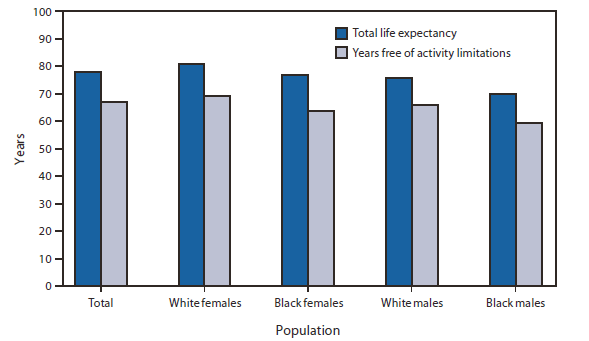
QuickStats: Life Expectancy and Years Free of Activity Limitations,* by Race and Sex --- United States, 2006


The figure shows the life expectancy and years free of activity limitations, by race and sex in the United States in 2006. In 2006, total life expectancy was greater for females than males and for whites than for blacks. Total life expectancy ranged from 80.6 years for white females and 76.5 years for black females to 75.7 years for white males and 69.5 years for black males. Expected years free of activity limitations was greatest for white females (69.1 years), followed by white males (65.7 years), black females (63.4 years), and black males (59.3 years).
* Estimates are based on data from the National Vital Statistics System and the National Health Interview Survey (NHIS). NHIS collects information in household interviews of a sample of the civilian noninstitutionalized U.S. population. Expected years free from activity limitations combines estimates of total life expectancy and prevalence rates of activity limitations associated with chronic conditions, which are determined from responses to several questions in the NHIS Family Core component. Questions and methods used to compute total life expectancy and expected years free of activity limitations are included in the source report.
In 2006, total life expectancy was greater for females than males and for whites than for blacks. Total life expectancy ranged from 80.6 years for white females and 76.5 years for black females to 75.7 years for white males and 69.5 years for black males. Expected years free of activity limitations was greatest for white females (69.1 years), followed by white males (65.7 years), black females (63.4 years), and black males (59.3 years).
Source: Molla MT, Madans JH. Life expectancy free of chronic condition-induced activity limitations among white and black Americans, 2000--2006. National Center for Health Statistics. Vital Health Stat 2010;3(34). Available at http://www.cdc.gov/nchs/data/series/sr_03/sr03_034.pdf Adobe PDF file.

St. John’s Regional Health Center: Following Heart Failure Patients After Discharge Avoids Readmissions - The Commonwealth Fund


Authors: 
Aimee Lashbrook, J.D., M.H.S.A., and 
Jennifer N. Edwards, Dr.P.H.


Contact: 
Aimee Lashbrook, J.D., M.H.S.A., 
Health Management Associates,
alashbrook@healthmanagement.com


Editor: 
Martha Hostetter

Downloads

Overview

St. John’s Regional Health Center (St. John's) has very low readmission rates among patients with heart attacks, heart failure, and pneumonia—the three conditions for which hospitals report readmission rates to the Centers for Medicare and Medicaid Services (CMS). Its rates are better than the top 10 percent of hospitals reporting (Exhibit 1).
Exhibit 1St. John's, like other hospitals profiled in this case study series, did not set out deliberately to reduce readmission rates. Rather, the hospital has had a longterm commitment to establishing and adhering to care standards to deliver optimal care. Staff follow evidence-based practices, educate patients about their conditions during their stay and after discharge, provide coordinated care, and manage chronic diseases by working with providers in the hospital and community.
In addition, St. John's low readmission rates for heart attack and heart failure patients may be attributed to the close attention it pays to patients after discharge and its engagement of the community's primary care physicians. Further, being part of a system and working in partnership with its health plan have influenced how the hospital approaches care coordination and cost-effective care.
This case study focuses on St. John's strategies and efforts to improve heart attack and heart failure care and reduce related readmissions.
Patient-focused interventions after discharge
  • telephone calls to all heart failure patients to answer questions and remind them about the importance of having a follow-up visit with their personal physician;
  • referrals to an outpatient cardiac rehabilitation program;
  • use of an interactive voice response telemonitoring program for heart failure patients;
  • 24-hour nurse triage help line to provide after-hours support;
  • medication assistance program for patients with limited resources; and
  • 24- to 48-hour follow-up by a St. John’s Health Plans care manager (for health plan members) to review discharge instructions, ensure patients have appointments with their personal physicians, check medications, and remove any barriers to following treatment plans.
Interventions focused on community providers
  • telephone and electronic notification to patients’ personal physicians about patients' hospitalization and need for follow-up visits within one week;
  • "call in, get in" standard of care, in which personal physicians make heart failure patients a priority; and
  • an electronic heart failure registry to track such patients' care over time.

This study was based on publicly available information and self-reported data provided by the case study institution(s). The aim of Commonwealth Fund–sponsored case studies of this type is to identify institutions that have achieved results indicating high performance in a particular area of interest, have undertaken innovations designed to reach higher performance, or exemplify attributes that can foster high performance. The studies are intended to enable other institutions to draw lessons from the studied institutions' experience that will be helpful in their own efforts to become high performers. Even the best-performing organizations may fall short in some areas or make mistakes—emphasizing the need for systematic approaches to improve quality and prevent harm to patients and staff. The Commonwealth Fund is not an accreditor of health care organizations or systems, and the inclusion of an institution in the Fund's case study series is not an endorsement by the Fund for receipt of health care from the institution.

Citation


A. Lashbrook and J. N. Edwards, St. John’s Regional Health Center: Following Heart Failure Patients After Discharge Avoids Readmissions, The Commonwealth Fund, April 2011.

Saturday, April 2, 2011

State-Based, Single-Payer Health Care — A Solution for the United States? | Health Policy and Reform

by William C. Hsiao, Ph.D.

The United States faces two major problems in the health care arena: the swelling ranks of the uninsured and soaring costs. The Patient Protection and Affordable Care Act (ACA) makes great strides in addressing the former problem but offers only modest pilot efforts to address the latter. Experience in countries such as Taiwan and Canada shows that single-payer health care systems can achieve universal coverage and control inflation of health care costs. Because of strong political opposition, however, the U.S. Congress never seriously considered a single-payer approach during the recent reform debate. Now Vermont, wishing to solve the intertwined problems of costs and access through systemic reform, is turning in that direction. Vermont Governor Peter Shumlin campaigned on a platform of single-payer health care, and Democratic legislative leaders are committed to this approach.

In Vermont, the status quo in health care has become untenable. Despite numerous reforms over the past 15 years, Vermont’s health care costs are escalating rapidly, straining the state budget, household incomes, and employers’ bottom lines. More than 7% of Vermonters are uninsured, and another 15% have inadequate insurance.

The Vermont Legislature passed Act 128 in May 2010 authorizing a study to find the most viable and practical systemic solutions to these problems.1 The goals are clear and ambitious: Vermont wants to achieve universal coverage, reduce the rate of cost increases, and create a primary care–focused, integrated delivery system. The question is how to achieve those goals. My team of health system analysts at the Harvard School of Public Health was commissioned by the Vermont Legislature to develop and evaluate three options for health system reform and determine which option would best achieve the stated goals.
More
Enhanced by Zemanta

Medicaid and Access to the Courts | Health Policy and Reform

West face of the United States Supreme Court b...Image via Wikipedia
by Sara Rosenbaum, J.D. in New England Journal of Medicine

The Medicaid program is grounded in a statute that is one of the most complex of all federal laws. An insurer of more than 60 million people — and poised to begin serving 16 million more by 2019 — Medicaid will be reexamined this year, in all its legal complexities, by the U.S. Supreme Court, which has agreed to hear California’s appeal in the case Maxwell-Jolly v. Independent Living Center of Southern California. The Court’s ruling could fundamentally alter states’ accountability to beneficiaries and providers when their official conduct allegedly violates Medicaid’s essential federal requirements.

The Maxwell-Jolly case was precipitated by a series of deep cuts to provider payments that were enacted by the California legislature and aimed at services used predominantly by the state’s most severely disabled beneficiaries. The payment reductions were halted by the U.S. Court of Appeals for the Ninth Circuit, but this action by no means ended the dispute. Indeed, the question before the Supreme Court is of far greater consequence than that of specific provider payments: it is whether beneficiaries and providers have the right to seek judicial redress when they allege that state conduct abridges federal law and threatens health and safety.
More
Enhanced by Zemanta

In Republicans' 2012 Budget Plan, Rep. Ryan Gives Social Security a Pass - TheHill.com

Rep. Paul Ryan (R-WI)Image via Wikipedia
By Erik Wasson

House Budget Committee Chairman Paul Ryan (R-Wis.) will largely give Social Security a pass in his highly anticipated budget while proposing a significant overhaul of Medicare and Medicaid, according to sources briefed on the plan.

The 2012 budget resolution, which committee Republicans are still finalizing, is scheduled to be unveiled on Tuesday. It will not back specific benefit cuts to Social Security or suggest raising the retirement age, sources said.

Instead, it will lay out the problems with the program and suggest authorizing committees tackle the specifics. It also will propose “trigger” thresholds for Social Security that, once reached, would ask the president to propose a way to fix the program.

Ryan is also not planning to include a proposal that would allow recipients to invest their Social Security payroll taxes, something Democrats have attacked as a “privatization” of Social Security. Such attacks doomed a 2005 effort by then-President George W. Bush to reform the system.
More
Enhanced by Zemanta

Combo Regimen Best to Keep Obese Seniors Going

By Todd Neale, Staff Writer, MedPage Today

Exercise and weight loss both appear to help obese older adults maintain function, although combining the two provides the most benefit, a randomized controlled trial showed.

After one year, participants 65 and older who participated in both a diet and exercise program had greater gains in physical performance than those who did either one alone, according to Dennis Villareal, MD, of the New Mexico VA Health Care System in Albuquerque, and colleagues.

The combined strategy also resulted in the most consistent gains on several secondary endpoints, including strength, balance, gait, and quality of life, the researchers reported in the March 31 issue of the New England Journal of Medicine.
More
Enhanced by Zemanta

OIG Posts New Information on Accountable Care Organizations

On March 31st, OIG posted new information on Accountable Care Organizations. Thhe links provided below will take you directly to the new material.

---------------------
Federal Agencies Address Legal Issues Regarding Accountable Care Organizations Participating in the Medicare Shared Savings Program
http://oig.hhs.gov/fraud/aco.asp

Today, as part of a cross-agency, coordinated effort, several Federal agencies issued documents addressing legal issues regarding Accountable Care Organizations participating in the Medicare Shared Savings Program
(Shared Savings Program).

The Centers for Medicare & Medicaid Services (CMS) issued a proposed rule that would establish accountable care organizations (ACO) under the Shared Savings Program. The CMS proposed rule is available online at
http://www.cms.gov/sharedsavingsprogram

CMS and HHS Office of Inspector General (OIG) jointly issued a notice with comment period outlining proposals for waivers of certain Federal laws-the physician self-referral law, the anti-kickback statute, and certain provisions of the civil monetary penalty law-in connection with the Shared Savings Program. CMS and OIG are also asking for comments on further waiver design considerations for the Shared Savings Program and for the separate waiver authority for the Center for Medicare and Medicaid Innovation under section 1115A of the Social Security Act. The joint notice with comment period is available online at
http://www.ofr.gov/inspection.aspx?AspxAutoDetectCookieSupport=1

The Federal Trade Commission and the Department of Justice jointly issued a "Proposed Statement of Enforcement Policy Regarding Accountable Care Organizations Participating in the Medicare Shared Savings Program" (Antitrust Policy Statement). The Antitrust Policy Statement is available online at:
http://www.ftc.gov/opp/aco/
 
And the Internal Revenue Service (IRS) issued a notice requesting comments regarding the need for guidance on participation by tax-exempt organizations in the Shared Savings Program through ACOs. The IRS notice
is available online at
http://www.irs.gov/newsroom/article/0,,id=222814,00.html

Enhanced by Zemanta