Showing posts with label demographics. Show all posts

Sunday, April 3, 2011

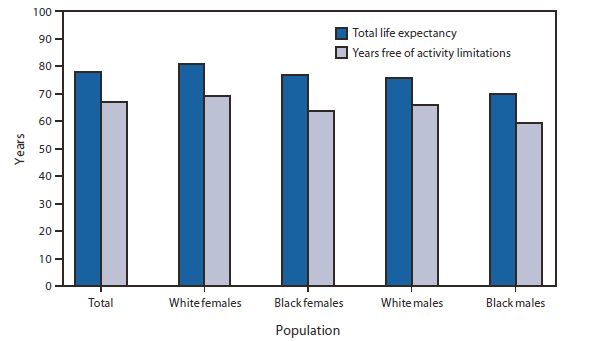
QuickStats: Life Expectancy and Years Free of Activity Limitations,* by Race and Sex --- United States, 2006


The figure shows the life expectancy and years free of activity limitations, by race and sex in the United States in 2006. In 2006, total life expectancy was greater for females than males and for whites than for blacks. Total life expectancy ranged from 80.6 years for white females and 76.5 years for black females to 75.7 years for white males and 69.5 years for black males. Expected years free of activity limitations was greatest for white females (69.1 years), followed by white males (65.7 years), black females (63.4 years), and black males (59.3 years).
* Estimates are based on data from the National Vital Statistics System and the National Health Interview Survey (NHIS). NHIS collects information in household interviews of a sample of the civilian noninstitutionalized U.S. population. Expected years free from activity limitations combines estimates of total life expectancy and prevalence rates of activity limitations associated with chronic conditions, which are determined from responses to several questions in the NHIS Family Core component. Questions and methods used to compute total life expectancy and expected years free of activity limitations are included in the source report.
In 2006, total life expectancy was greater for females than males and for whites than for blacks. Total life expectancy ranged from 80.6 years for white females and 76.5 years for black females to 75.7 years for white males and 69.5 years for black males. Expected years free of activity limitations was greatest for white females (69.1 years), followed by white males (65.7 years), black females (63.4 years), and black males (59.3 years).
Source: Molla MT, Madans JH. Life expectancy free of chronic condition-induced activity limitations among white and black Americans, 2000--2006. National Center for Health Statistics. Vital Health Stat 2010;3(34). Available at http://www.cdc.gov/nchs/data/series/sr_03/sr03_034.pdf Adobe PDF file.

Tuesday, March 29, 2011

Challenges for Asia as It Grows Old - NYTimes.com

Image representing New York Times as depicted ...Image via CrunchBase
By ALAN WHEATLEY | REUTERS

If demography is destiny, as the French philosopher Auguste Comte put it, then Asia faces daunting challenges in the coming decades.

Markets understandably track the rate and composition of gross domestic product to gauge short-term economic shifts. But it is changes to the underlying productive capacity of an economy that count in the long run. Swing factors include openness to outside capital and ideas as well as the quality of education and governance.

Another is the effect of population trends on the supply of labor and on savings and investment rates. Witness North Africa and the Middle East. One reason behind the turmoil engulfing the region is the failure of governments to address a youth bulge, spawning large cohorts of angry, unemployed young men.

With the notable exception of India, most Asian countries have the opposite problem. The region is growing old, as painfully illustrated by the March 11 earthquake in northeast Japan.
More
Enhanced by Zemanta

Friday, February 18, 2011

In The Last 6 Months Of Life, Medicare Costs Are Driven By Patient Variables Twice As Much As Geography

Mount Sinai School of Medicine logo.pngImage via Wikipedia
A study by Mount Sinai School of Medicine finds that Medicare costs at the end of life are influenced more by patient characteristics, such as ability to function, the severity of the illness, and family support than by regional factors, such as the number of hospital beds available. The study will be published February 15 in The Annals of Internal Medicine.

"These new findings show that the reasons for wide variation in Medicare costs across the United States are much more complicated than previously thought," said lead author Amy Kelley, MD, Assistant Professor in the Department of Geriatrics and Palliative Medicine at Mount Sinai School of Medicine. "The health care system should address the specific needs of patients, rather than focusing solely on the difference we see across regions. That means we need to extend care beyond the standard single disease-oriented models of care," added Dr. Kelley.

Prior studies had shown dramatic geographic variation in Medicare costs among people with chronic illnesses, especially near the end of life. However, they did not take into account individual patient characteristics, such as a person's ability to walk and take care of themselves, day-to-day.

For this new study, researchers from Mount Sinai and the University of California, Los Angeles (UCLA) examined 2,400 older adults from across the United States, as well as characteristics of their local health care system, to explore which factors were related to Medicare expenses in their last six months of life. Impairment or decline in a person's function, or the ability to take care of him or herself, was a strong predictor of higher Medicare costs - even more so than their medical conditions.

Regional factors, such as having more hospital beds or a pattern of high-intensity practice also predicted higher Medicare expenses. But overall, this study determined that patient characteristics explained ten percent of the Medicare cost variation, double the cost variation attributed to regional factors - five percent.

"This raises additional questions that future research will need to address, such as why it is that having family nearby is associated with lower Medicare costs," said Catherine Sarkisian, MD, Associate Professor in the Division of Geriatrics at UCLA and senior author on the study. "Having a caregiver available may help people avoid undesired hospital stays. If so, future research must look at the impact on families that take on the expense and burden of care giving."

According to Dr. Kelley, the study's findings suggest that, "Health care reform will have the greatest impact on reducing costs if we focus on providing well-coordinated, high-quality care for the most complicated patients and their family caregivers."

Source:
Mount Sinai
The Mount Sinai Hospital / Mount Sinai School of Medicine
Enhanced by Zemanta

Wednesday, February 16, 2011

Gap Seen in Readmit Rates by Race, Location

By Michael Smith, North American Correspondent, MedPage Today

Older black patients admitted to hospital for three common conditions -- congestive heart failure, heart attack, or pneumonia -- are 13% more likely than whites to be readmitted within a month, researchers reported.

But the analysis of Medicare discharge data for more than three million patients, also found disparities related to where patients get care -- both blacks and whites treated at hospitals with a large proportion of black patients had even higher readmission rates, according to Karen Joynt, MD, PhD, of Brigham and Women's Hospital in Boston, and colleagues.

Overall, about one in five older patients admitted to the hospital with heart failure, MI, or pneumonia were readmitted within 30 days, Joynt and co-authors wrote in the Feb. 16 issue of the Journal of the American Medical Association.

Read More
Enhanced by Zemanta

Wednesday, February 2, 2011

Pew Research Center's Internet & American Life Project

Health information remains one of the most important subjects that internet users research online. Symptoms and treatments continue to dominate internet users' health searches, but food safety, drug safety, and pregnancy information are among eight new topics included in the current survey. In all, 80% of internet users gather health information online. Read more.

Wednesday, January 5, 2011

Working on Some Ideas « ChangingAging.org

by Dr Bill Thomas

I am putting together a summary of a book I am starting to write and I’m inviting ChangingAging readers into the process. Here is the opening to the overview.
The people who were born after World War II, the people we have long called the “Baby Boomers,” have exercised an extraordinary influence over American society. During the fifties, their overwhelming numbers led Gerber to introduce baby-sized portions of pre-cooked meats and vegetables. As mobile teenagers they developed a taste for fast food that transformed a single California hamburger stand into the global McDonalds corporation. When, as adults, they decided to lose some extra pounds jogging became a national craze and an Oregon sneaker company named Nike joined the Fortune 500. Now, the Post War generation, is embracing social media on a mass scale. Social media use among older adults grew 100 percent last year, so that one in four (26 percent) people in that age group online are now logging in to Facebook, Twitter and the like, reports the Pew Internet and American Life Project in a recent study. Not coincidentally, Facebook is now a 500 billion dollar company.
Global aging is a well established phenomenon. Indeed, among all the human beings who have lived to see old age, in all of human history, more than half are living among us right now. This demographic trend is destined to explode within American society as the Post War generation races toward late adulthood. Already, an American turns 65 every 10.8 seconds. These numbers, while staggering, are easily understood. Much more difficult to comprehend are the personal and cultural consequences of this shift. A massive population, with a proven ability to transform society, is about to encounter the boundary between life’s second and third stages. Unlike all previous human generations, they will struggle to find their way forward as members of a youth obsessed society and without access to the ceremonial initiations or guiding rituals that have historically smoothed the passage out of adulthood and into elderhood. This radical unpreparedness will make this, the Post War generation’s second crucible, much more challenging than its first.
Tomorrow: What is a Crucible?
Working on Some Ideas « ChangingAging.org
Enhanced by Zemanta

Monday, October 18, 2010

As Populations Age, a Chance for Younger Nations - NYTimes.com

My Grandfather (†); photo from January 17.JPGImage via WikipediaBy TED C. FISHMAN

YOU MAY KNOW that the world’s population is aging — that the number of older people is expanding faster than the number of young — but you probably don’t realize how fast this is happening. Right now, the world is evenly divided between those under 28 and those over 28. By midcentury, the median age will have risen to 40. Demographers also use another measure, in addition to median age, to determine whether populations are aging: “elder share.” If the share, or proportion, of people over 60 (or sometimes 65) is growing, the population is aging. By that yardstick too, the world is quickly becoming older. Pick any age cohort above the median age of 28 and you’ll find its share of the global population rising faster than that of any segment below the median. By 2018, 65-year-olds, for example, will outnumber those under 5 — a historic first. In 2050, developed countries are on track to have half as many people under 15 as they do over 60. In short, the age mix of the world is turning upside down and at unprecedented rates.

This means profound change in nearly every important relationship we have — as family members, neighbors, citizens of nations and the world. Aging populations also alter how business is done everywhere.
Continue Reading
Enhanced by Zemanta

Tuesday, August 31, 2010

Baby Boomers Are 40 To 50 Percent More Likely To 'Disaffiliate' From Their Faith

Generation X, the set of Americans who came of age in the late 1980s and early 1990s, is often branded as a rules-rejecting, authority-questioning group.

But when it comes to religion, new research has revealed that Gen-Xers are surprisingly loyal to their faith - a finding that also suggests the rising non-religious tide in the United States may be leveling off.

In a study published in the latest edition of The Journal for the Scientific Study of Religion, University of Nebraska-Lincoln sociologist Philip Schwadel showed that Gen-Xers are, in comparison with their Baby Boomer predecessors, far more likely to adhere to their religion. In fact, Boomers are 40 to 50 percent more likely than Gen-Xers to "disaffiliate" from their faith.

As Generation X continues to grow older, this loyalty may translate into a more stable nation in terms of its religiosity, he said.

Schwadel examined General Social Survey responses from more than 37,000 Americans from 1973 to 2006. Using age, period and cohort models, the research zoomed in on two aspects of U.S. religious behavior through the decades:
  • Non-affiliation, which is the total percentage of Americans not involved with any particular religion; and
  • Disaffiliation, which measures those who had a religious affiliation while they were adolescents but then had no affiliation at the time they were surveyed.
"The proportion of Americans with no religious affiliation doubled in the 1990s and has continued to rise in the 21st century," Schwadel said. "With the decline in religious disaffiliation among post-Boomer cohorts, it is possible that this growth in non-affiliation may soon level off."

Though Generation X's religious adherents are relatively durable, the generation as a whole is still more likely than previous ones to be raised with no religious preference, according to the research. Religious non-affiliation in the United States grew from between 6 percent and 8 percent in the 1970s and 1980s to nearly 16 percent by 2006.

Like previous researchers, Schwadel attributes this to the so-called "1960s effect" -- Americans who were children and young adults in the 1960s were disproportionately likely to disaffiliate with religion compared with previous generations. Consequently, many Boomers raised their Gen-X children in a non-religious environment.

Schwadel's research, however, shows that Gen-Xers are behaving differently than their parents. Although Gen-Xers are relatively likely to be raised with no religious affiliation, those who are raised with a religious affiliation are considerably less likely than their parents to separate from religion.

So why are religious members of Gen-X so much less likely to leave religion? For one, Schwadel said, the American religious scene is more dynamic and textured than it was when Baby Boomers were coming of age in the '60s and '70s, which has left the younger generation more choices. If they aren't happy with a particular religion, they can more easily find a substitute instead of falling away entirely.

"Social scientists have noted that what we call the 'religious marketplace' has greatly expanded in recent decades," Schwadel said. "Historically, it was thought that this religious pluralism was detrimental to the vitality of American religion. While many still hold this view, others suggest that more choices lead to greater religious affiliation and commitment."

The long-term impact of the decline in disaffiliation among post-Boomers remains to be seen, he said.
"While this trend is good news for those who worry about declining religious adherence, the Boomers' enmity toward organized religion is still evident in the relatively large proportion of their children and grandchildren who are raised with no religious affiliation," Schwadel said.

Source: Philip Schwadel - University of Nebraska-Lincoln

Enhanced by Zemanta

Wednesday, August 25, 2010

Info Long-Term Care: New Realities of an Older America

From the Stanford Center on Longevity, this report examines the major changes, challenges and decisions faced with baby boomers reaching old age and the diversity of the aging population for families, workplaces, and communities.

The implications concern young and old alike. Although many of these changes have been anticipated, the United States has relied on social and economic policies and practices designed for a more youthful population.
Full Report (PDF)


Enhanced by Zemanta

Saturday, August 14, 2010

Older Patients' Share of Office Visits Grows from MedPage Today

By Charles Bankhead, Staff Writer, MedPage Today

Older patients account for a majority of physician office visits, which increasingly involve specialists who treat chronic conditions, according to government statistics.

Patients 45 and older made 57% of all physician office visits in 2008, compared with 49% in 1998. Medical and surgical specialists accounted for 55% of office visits among patients 65 and older and 48% of visits among patients ages 45 to 64.

U.S. demographics virtually assure that the trends in physician-service use will continue, possibly at a more rapid pace, findings from a study by the National Center for Health Statistics (NCHS) suggest.

Continue Readingng

Friday, July 2, 2010

Disability.gov: A New Federal/Private Model Promotes Financial Well Being for Americans with Disabilities

By Guest Blogger Dr. Johnette Hartnett, Director of Strategic Partnership Development, The National Disability Institute’s Real Economic Impact Tour and Burton Blatt Institute, Syracuse University

Imagine an unlikely partnership between federal agencies, private sector partners, universities and nonprofits, collectively championing the rights of taxpayers with disabilities.

Now, what at first seemed improbable has become reality. Over the past six years, the National Disability Institute’s Real Economic Impact Tour has established a groundbreaking federal/private model for promoting tax education and financial well-being to Americans with disabilities nationwide.

Thanks to key sponsors like Bank of America, AT&T, Walmart, Acorda Therapeutics, Inc. and others, we've delivered funding and asset-building programs to cities in all 50 states. Since 2005, our partnerships with the IRS and 100 community-based organizations have resulted in free tax filing assistance for more than 650,000 taxpayers with disabilities – representing more than $600 million in returns and more than $120 million in saved preparer fees.

Yet, while we’re pleased to celebrate the above milestones as part of the 20th Anniversary of the ADA, we know there’s much work ahead to ensure that all Americans with disabilities have access to the economic mainstream. Especially considering the following:

  • 37 million Americans live in poverty, and 13 million are children less than 18 years of age
  • 38 million Americans subsist on food stamps
  • 50 million Americans, in any given month, are on Medicaid
  • 57 percent of unemployed Americans receive unemployment compensation compared to 40 percent before the recession
  • 61 percent is the increase in homelessness in America since December 2007
  • 40 percent of Americans accessing food shelters and pantries are people on Supplemental Security Income (SSI) and Social Security Disability Insurance (SSDI)
  • 65 percent of Americans experiencing long-term poverty (greater than a year) are persons with disabilities

The above 65 percent translates into more than 54 million Americans – clearly, not a niche market. In fact, it's a market larger than the United States’ African-American, Latino and Gay markets combined; a market that wields 17 times the spending power of tweens 8-12 years old. It's a market not to be ignored.
Continue Reading
Enhanced by Zemanta

Friday, June 11, 2010

Diversity Toolkit

The U.S. Administration on Aging just released an online “Toolkit for Serving Diverse Communities.”

This Toolkit provides the Aging Network and its partners with a replicable and easy-to-use method for providing services for any diverse community.

The Toolkit consists of a four-step process and a questionnaire that assists professionals, volunteers and grassroots advocates with every stage of program planning, implementation and service delivery for older adult communities, their families and caregivers.

The core principles of the toolkit include respect, inclusion and sensitivity as the hallmarks of quality service.
This Toolkit is an invitation to agencies and their partners to make a cultural shift in service provision, to learn, to grow and fully appreciate the diverse community of older adults they serve.

The Toolkit can be found at:
http://www.aoa.gov/AoAroot/Press_Room/For_The_Press/pr/archive/2010/June/DiversityToolkit.aspx

Diversity Toolkit

Tuesday, May 25, 2010

As longevity grows, the world might become a better place

By Fred Pearce

Ushi Okushima is the oldest resident of Ogimi, the most elderly community in Japan, the country where the average age is higher than anywhere else in the world. At 108, she still takes to the floor for traditional Japanese dances. Afterward she dabs a little French perfume behind her ears and sips the local firewater. If an aging population is on the way, she is not a bad advertisement for what we have in store.

The Land of the Rising Sun has become the land of the setting sun with staggering speed. As recently as 1984, Japan had the youngest population in the developed world, but by 2005 it had become the world's most elderly country. Soon it will become the first country where most people are older than 50.
Continue Reading

Monday, March 22, 2010

MMI Quick Facts - March Issue

MetLife Inc.Image via Wikipedia

QuickFACTS is a monthly fact sheet produced by the MetLife Mature Market Institute. Its focus is the emerging market of people 50+. It is a compilation of recent news and developments on multi-generational issues that impact business and customers.

The March issue contains articles on: The Growing Grandparent Population; Planning for Phased Retirement; Caregivers: Help Needed; International Ageing and the Multi-Generational Workforce; The Joy of Pumping Iron; Older Workers Staying Put; Changing Landscape of Retirement Destination States; and 100 Year Old Athlete Wins the Gold and Sets a Record!
Read More
Reblog this post [with Zemanta]

Thursday, March 18, 2010

When Does 'youth' End And 'old Age' Begin? Results From The European Social Survey

Subregions of Europe (UN geoschme)Image via Wikipedia

(Medical News Today) With a steadily growing proportion of older people in the UK and Europe, the 2008 European Social Study included a module that examined how people perceive and feel about their own and other age groups.

Professor Abrams explained: 'The survey showed that age prejudice being treated as 'too young' or 'too old' is perceived to be a serious or very serious issue by 63 per cent of respondents, so it is obviously important to know what these age labels mean to people'. To find out, the survey asked when does 'youth' end and 'old age' begin? For the UK, the average response to this question was that youth ends at the age of 35 and old age begins at 58.

However, the survey also revealed that people's judgments depend strongly on the 'age of the beholder'. On average, the youngest respondents (15 to 24-year old) judged that youth ends at 28 and old age starts at 54, whereas the oldest age group (80 and older) judged that youth ends at 42 and old age starts at 67.

In the UK, there is a gap of almost 40 years between young people's judgment of the end of youth and older people's judgment of the beginning of old age. However, more startlingly, there is a gap of only 12 years between older people's judgment of the end of youth and younger people's judgment of the start of old age.

In general, men regarded the end of youth and start of old age to begin two years earlier than women did.

There were also large differences between European countries. Youth was perceived to end earliest among respondents in Portugal (at the age of 29) and latest by those in Cyprus (at the age of 45). Portugal scored lowest for the belief when old age starts (at the age of 51), whereas Belgium ranked highest (at the age 64).

The findings illustrate that when people discover another person's age, their judgment of whether that person is young or old is highly subjective and this may have important implications in influencing people's assumptions about the person's responsibilities, rights and capabilities.

Professor Abrams said: 'This evidence shows that what counts as young and old is very largely down to the age of the beholder.'

Amongst other findings, the survey also showed that 28 per cent of UK respondents reported that they had been treated with prejudice because of their age in the past year and that the youngest age group were more likely to report experiences of prejudice than any other. Across the European countries in the survey, age prejudice was most widely reported in Finland (47 per cent) and least so in Cyprus and Portugal (19 per cent). The UK ranked 16 out of 21 countries in regard to this question.

Read More
Reblog this post [with Zemanta]

Thursday, March 11, 2010

American Indian Elder Health: Critical Information for Researchers and Policymakers

As more American Indians and Alaska Natives (AIAN) live to adulthood and old age, the elderly population (age 55 and older) is projected to increase from 5.5% of the total U.S. AIAN population in 1990 to 12.6% in 2050. This shifting demographic profile of the population calls for focused attention on the health status of AIAN elders.
Read/Download Fact Sheet

Wednesday, March 10, 2010

Alzheimer's Disease More Prevalent in Blacks, Hispanics from MedPage Today

By Joyce Frieden, News Editor, MedPage Today

African Americans and Hispanics are much more likely than whites to develop Alzheimer's disease and other dementias, according to new figures from the Alzheimer's Association.

African Americans are about twice as likely as whites to develop these disorders, and Hispanics are about 1.5 times as likely, according to the association's 2010 Alzheimer's Disease Facts and Figures report.

Still, white males make up the great majority of the 5.3 million Americans with the disease.

Scientits aren't sure what genetic factors predispose people to Alzheimer's, but African Americans and Hispanics have a greater risk of developing hypertension and diabetes -- known risk factors for Alzheimer's and other dementias, the association said in a statement.
Continue Reading


Reblog this post [with Zemanta]

Wednesday, March 3, 2010

Gov't adopts formula that doubles elderly poor

By HOPE YEN

The government took steps Tuesday to highlight the increasing numbers of poor Americans, adopting a revised formula that is expected to double the number of older people classified as living in poverty to nearly 1 in 5.

Under the new formula, overall poverty is expected to increase from 13.2 percent, or 39.8 million people, to 15.8 percent, or 47.4 million, mostly due to rising expenses from medical care and other factors.

The new measure will not replace the official poverty rate but will be published alongside the traditional figure next year as a "supplement" for federal agencies and state governments, according to the directive announced Tuesday by the Commerce Department and White House.
Continue Reading
Reblog this post [with Zemanta]

The MetLife Study of Boomers in the Middle

MetLife Inc.Image via Wikipedia

This report is an in-Depth look at Americans born 1952 - 1958.

The Baby Boomer generation, typically, has been characterized as a bloc of people who think and act as one monolithic generation, when it actually comprises three separate cohorts. This study found that there are distinct differences between these Middle Boomers and their older and younger generation mates.
Continue Reading

Download Report
Reblog this post [with Zemanta]