by Medpage Today staff
A finding that a common laboratory staining agent increased longevity
in nematode worms may have implications for human lifespan as well,
researchers suggested.
Thioflavin T is a widely used, yellow histological dye, used for such
tasks as staining amyloid plaques and stabilizing protein fibrils in
cultures.
But researchers led by Gordon Lithgow, PhD, of the Buck Institute for
Research on Aging in Novato, Calif., thought the stabilizing effect
might have a wider application. They exposed adult nematodes –- the
standard lab species Caenorhabditis elegans -- to the substance and found that it extended their lives by about 60%.
It also suppressed some of the pathological features of aging in the worms, the group reported online in Nature.
The hypothesis is that the stabilizing effect of the substance helps
to preserve normal protein homeostasis and prevent aggregation of
proteins, including the accumulation of amyloid-beta that's
characteristic of Alzheimer's.
This blog tracks aging and disability news. Legislative information is provided via GovTrack.us.
In the right sidebar and at the page bottom, bills in the categories of Aging, Disability, Medicare, Medicaid, and Social Security are tracked.
Clicking on the bill title will connect to GovTrack updated bill status.
Showing posts with label longevity. Show all posts
Saturday, April 2, 2011
Wednesday, February 23, 2011
Endurance Exercise Prevents Premature Aging: McMaster Study
Endurance exercise may stop you looking and feeling old, it may even help you live longer, a study by McMaster University researchers has found.
"Many people falsely believe that the benefits of exercise will be found in a pill," said Mark Tarnopolsky, principal investigator of the study and a professor of pediatrics and medicine of the Michael G. DeGroote School of Medicine. "We have clearly shown that there is no substitute for the "real thing" of exercise when it comes to protection from aging."
The study, published today in the prestigious science journal Proceedings of the National Academy of Sciences (PNAS), found that premature aging in nearly every organ in the body was completely prevented in mice that ran on a treadmill three times a week for five months.
More
Monday, February 21, 2011
Social Security Improvements And Longer Life Span Linked By Study
New findings from researchers at New York Medical College suggest that when Social Security benefits are improved, people over the age of 65 benefit most, and may even live longer.
According to a new study published in the Journal of Public Health Policy, Americans over the age of 65 experienced steep declines in the rate of mortality in the periods that followed the founding of and subsequent improvements to Social Security. The authors urge that as Congress and the President discuss changes to Social Security they consider the benefit of reduced mortality and improved health among older Americans.
"The political discourse around Social Security focuses exclusively on the system's long-range financial problems rather than on the benefits of improved health and reduced poverty," said Peter Arno, Ph.D., the study's lead author and professor and director of the doctoral program in the Department of Health Policy and Management of the School of Health Sciences and Practice at New York Medical College. "If Social Security is put on the chopping block, lawmakers will jeopardize the most important safety net for America's elderly."
Arno - whose work is funded through a Robert Wood Johnson Foundation® Investigator Award in Health Policy Research - and his colleagues analyzed the effect of Social Security on mortality over the course of the 20th century. After controlling for factors such as changes in the economy, access to medical care, and Medicare, they found that although mortality rates for all adults fell during the 20th century, rates of decline for those 65 and older changed more than 50 percent in the decades following the introduction of Social Security in 1940. Rates of decline for the younger age groups remained virtually the same during this period. The trend was particularly pronounced following marked improvements in Social Security benefits between the mid-1960s and the early 1970s.
More
Scientists Demonstrate That Environmental Lithium Uptake Promotes Longevity
Professor Dr. Michael Ristow's team along with Japanese colleagues from universities in Oita and Hiroshima have demonstrated by two independent approaches that even a low concentration of lithium leads to an increased life expectancy in humans as well as in a model organism, the roundworm Caenorhabditis elegans. The research team presents its results in the online edition of the scientific publication European Journal of Nutrition which is now online.
Lithium is one of many nutritional trace elements and is ingested mainly through vegetables and drinking water. "The scientific community doesn't know much about the physiological function of lithium", project manager Ristow says. According to an earlier study from the US, highly concentrated lithium showed to be life-prolonging in C. elegans, the Professor of Nutrition in Jena continues. "The dosage that was analyzed back then, however, is clearly beyond the physiologically relevant range and may be poisonous for human beings", explains Ristow. To find out if lithium has a life-prolonging impact at much lower concentrations, the scientists then examined the impact of lithium in a concentration that is regularly found in ordinary tap water.
In a collaborative effort with Japanese colleagues, the Jena scientists analyzed the mortality rate in 18 adjacent Japanese municipalities in relation to the amount of lithium contained in tap water from the respective regions. "We found that the mortality rate was considerably lower in those municipalities with more lithium in the drinking water", Ristow explains the key finding. In a second experiment, the Jena scientists examined exactly this range of concentration in the model organism C. elegans. The result was confirmed: "The average longevity of the worms is higher after they have been treated with lithium at this dosage", Ristow says.
Even though the underlying mechanisms still needs to be clarified, the scientists assume that the higher longevity they observed in humans as well as in nematodes C. elegans can be induced by the trace element lithium.
Moreover, the scientists speculate about using low-dose lithium as a potential dietary supplement in the future. "From previous studies we know already that a higher uptake of lithium through drinking water is associated with an improvement of psychological well-being and with decreased suicide rates", Professor Ristow explains. While low-dose lithium uptake on the basis of the new data is clearly thought to be beneficial, more studies will be necessary to thoroughly recommend such a supplementation, the scientists conclude.
Original Publication:
Zarse K., Terao T., Tian J., Iwata N., Ishii N., Ristow M. Low-dose lithium uptake promotes longevity in humans and metazoans. Eur J Nutr 2011, DOI: 10.1007/s00394-011-0171-x
Source:
Ute Schoenfelder
Friedrich-Schiller-Universitaet Jena
Tuesday, February 15, 2011
Fiber-Full Diet Lengthens Life
By Crystal Phend, Senior Staff Writer, MedPage Today
Getting lots of dietary fiber appears to reduce the risk of dying -- particularly from cardiovascular, infectious, or respiratory diseases -- according to a large observational study.
The study of more than 500,000 people found those with the highest dietary fiber intake -- an average of 29.4 grams per day for men and 25.8 for women -- had a 22% lower risk of dying from any cause over nine years of follow-up compared with those with the lowest fiber intake -- a mean of 12.6 grams per day for men and 10.8 for women -- (P<0.001 for trend), Yikyung Park, ScD, of the National Cancer Institute in Rockville, Md., and colleagues found.
Higher fiber consumption lowered the risk of death from cardiovascular, infectious, and respiratory diseases by 24% to 56% in men and by 34% to 59% in women, Park and co-authors reported online in the Archives of Internal Medicine.
Full Article
Wednesday, January 12, 2011
U.S. Life Expectancy Declines : Discovery News
Life expectancy has dropped slightly for all Americans except for black men, who gained around two and a half months in longevity, according to a recent report.
Data gathered by the National Center for Health Statistics showed that life expectancy for most American men was 75.3 years in 2008, down by one-tenth of a year from 2007.
Women also saw a drop in the number of years they can expect to live, from 80.4 years to 80.3 years, the data show.
Black men, on the other hand, bucked the trend and reached a record-high life expectancy of 70.2 years in 2008, up by 0.2 years compared to 2007.
Heart disease remained the leading cause of death in the United States, followed by cancer, chronic lower respiratory diseases, stroke and accidental injury.
The sixth leading cause of death was Alzheimer's disease, one of six diseases or causes for which the age-adjusted death rate increased significantly, the study says.
A study released in October said the United States ranked 49th in the world for male and female life expectancy, a precipitous drop from the fifth place it held in 1950.
Full Article
Wednesday, January 5, 2011
Sunday, October 24, 2010
The Next Public Health Crisis: Longevity - NYTimes.com
Since her appointment as dean of the Mailman School of Public Health at Columbia University in 2008, Dr. Linda P. Fried, a geriatrician, has sought to make the dramatic aging of the world’s population, and its myriad ramifications, one of the pillars of education for the 1,100 graduate students there.
Since 1900, life expectancy for the average American has increased by three decades, creating a host of medical, financial and public policy challenges. Just as the school took on AIDS in the 1980s and emergency preparedness in the wake of 9/11, so it is now scrambling to prepare its students to turn this age wave from a public health emergency to an opportunity.
Rigorous exploration of the subject is now high on the school’s agenda. A study by Mailman researchers, released early this month, explored the causes of the lag in life expectancy in the United States, compared with more than a dozen other countries. To the researchers’ surprise, the likely suspects — obesity, smoking, traffic accidents and homicide — were not to blame for the disparity.
Full Article
Related articles
- Why Americans Lag in Life Expectancy -- Even as Health Care Spending Soars (dailyfinance.com)
- Maybe Health Care Reform Was Necessary (alan.com)
- US care 'to blame' for poor health (bbc.co.uk)
Wednesday, October 20, 2010
From Taft to Obama, Victrola to DVD - Secrets of the Centenarians - NYTimes.com
Centenarians alive today are older than the Titanic, crossword puzzles and Mickey Mouse. They have lived through 19 presidencies and two world wars. They saw the rise of motion pictures and radio, followed by the invention of television.
Some traveled here long ago as immigrants; others have spent their entire lives in one small town. They have celebrated golden anniversaries and beyond, and witnessed the birth of great-grandchildren and great-great-grandchildren.
Many of them are still happy to be driving, dancing, walking or simply breathing. But others are clinging to their remaining abilities and wondering if they are too much of a burden to their loved ones.
Not surprisingly, the question they hear most often is “What is the secret to a long life?”
Complete Article
Tuesday, October 19, 2010
100 Years and Counting - NYTimes.com
In Tuesday’s Science Times, columnist Jane E. Brody explores recent research on why some us live to ripe old ages.
100 Years and Counting - NYTimes.comGenes do play a role in longevity. Dr. Nir Barzilai, a geneticist at the Albert Einstein College of Medicine in New York, reports that centenarians are 20 times as likely as the average person to have a long-lived relative. But a Swedish study of identical twins separated at birth and reared apart concluded that only about 20 to 30 percent of longevity is genetically determined. Lifestyle seems to be the more dominant factor.Read “Secrets of the Centenarians,” and share your thoughts over at the Well blog. And don’t miss the accompanying photos and audio, put together by health producer Karen Barrow, photo editor Soo-Jeong Kang and their colleagues.
Sunday, October 10, 2010
Evidence for health reform? You bet...your life - FierceHealthcare
By Dan Bowman
A poorly run healthcare system that focuses more on profits and less on quality is likely the reason Americans have shorter life expectancies than people in 12 other developed nations, a new study published in the journal Health Affairs concludes.
Researchers Peter Muennig and Sherry Glied with the Mailman School of Public Health at Columbia University looked at the 15-year survival rates for men and women between the ages of 45 and 65 from 1975 to 2005, taking into consideration the high rates of smoking, obesity, traffic fatalities and homicides in the U.S. They determined that while U.S. rates for all of those trends were comparable with the other 12 nations--Australia, Austria, Belgium, Britain, Canada, France, Germany Italy, Japan, the Netherlands, Sweden and Switzerland--the U.S. was the only one that doesn't provide universal health coverage.
Full Article
Despite high healthcare spending, America is lagging in life expectancy | Healthcare Finance News
by Chelsey Ledue, Associate Editor
Despite spending a lot of money on healthcare, the United States continues to lag behind other nations when it comes to gains in life expectancy, according to a Commonwealth Fund-supported study published today as a Health Affairs Web First.
The study looked at health spending, behavioral risk factors like obesity and smoking and 15-year survival rates for men and women ages 45 and 65 in the United States and 12 other countries (Australia, Austria, Belgium, Canada, France, Germany, Italy, Japan, the Netherlands, Sweden, Switzerland, and the United Kingdom).
Full Article
Thursday, August 26, 2010
Lookin' Good In Those Genes | Medicare Solutions Blog
People all over the world are living longer. Worldwide, few people reach the age of 100, and those who do are often celebrated for their longevity. Only one out of every six thousand people will blow out the candles on their 100th birthday cake. Even fewer people (one out of every seven million) have lived beyond age 100 into their 110s or 120s. Currently, the United States and Japan are home to the largest numbers of people aged 100 or older world wide.
But how can you live such a long life?
Continue Reading
Wednesday, August 25, 2010
Info Long-Term Care: New Realities of an Older America
From the Stanford Center on Longevity, this report examines the major changes, challenges and decisions faced with baby boomers reaching old age and the diversity of the aging population for families, workplaces, and communities.
The implications concern young and old alike. Although many of these changes have been anticipated, the United States has relied on social and economic policies and practices designed for a more youthful population.
Full Report (PDF)
The implications concern young and old alike. Although many of these changes have been anticipated, the United States has relied on social and economic policies and practices designed for a more youthful population.
Full Report (PDF)
Sunday, August 22, 2010
Genetic Markers for Living to 100 Years?: Topol on Genomics
A paper in Science, July 1, 2010, entitled "Genetic Signatures of
Exceptional Longevity in Humans," by Paola Sebastiani and colleagues
from Boston University has generated intense interst and controversy.
Below is a transcript of Dr. Topol's post on The Big Flap About Pathway Genomics and Walgreen's.
The topic is exceptional longevity, and can we predict it. This is an outgrowth of the Science paper by Sebastiani and colleagues, including Thomas Perls from Boston University, [published] July 1st in Science. This paper has been responsible for generating quite a controversy, which we will get into in a minute. Basically, the main finding for looking at a large group of centenarians that the New England group has accumulated over many years and doing a genome wide association study compared to a potpourri of controls --controls that came from the Illumina database, controls that included children of parents who had died in their 70s, and even a group of Parkinson’s disease patients -- so this was one of the concerns. Another one that was raised in the post-publication phase was the problem with the chips. That is, there were different chips that were tested, one that looked at 310,000 SNPs and another one that looked at 670,000 SNPs. These were not used in all the patients, so there was some lack of potential quality control regarding the SNP markers. Nonetheless, what this group concluded in Science was that using 150 SNPs, one could predict with 77% accuracy whether you would live to centenarian status, which is a pretty big jump, of course, for not only today. It is very difficult to predict longevity. Now this has come under siege. There have been reports in the New York Times. There was a Newsweek article that was entitled “The Little Flaw in Longevity-Gene Study That Could Be a Big Problem.” There are all sorts of things in the blogosphere such as “Serious Flaws Revealed in ‘Longevity Gene’ Study” [by Daniel MacArthur]. The critical issue, though, is whether these data will hold up to reanalysis. The investigators will have to redo the model that predicts exceptional longevity, taking out the SNPs that are now known to be faulty, and see whether or not, with the replication that they had, it will all hold up. Probably there will be some dilution of the effect, but some of the genes that came out of this study like TOM40, which is a known major modulator of the APOE locus adjacent to this gene, and which has already been implicated in longevity, itself were quite striking. So, we will have to see what this will turn out. This is quite a controversial study. Longevity and the science of aging is an area of fascination, and I would be interested to get your thoughts. What was really striking was that a Wall Street Journal poll that was conducted in the days after the Science paper asked how many people would like to know whether they carry the gene markers for exceptional longevity, and 75%of people (who at least read the Wall Street Journal and go onto its website and vote) wanted to get this information.
Related articles by Zemanta
- Can a gene test tell you whether you'll live to 100? (newscientist.com)
- Deleted Scenes: Critics point to flaws in longevity study (sciencenews.org)
- Serious flaws revealed in "longevity genes" study (scienceblogs.com)
- Genes predict living beyond 100 (news.bbc.co.uk)
Wednesday, August 11, 2010
The Longevity Prescription of Dr. Robert Butler: A Proposal - Time Goes By
by Ronni Bennett
Over the weekend, I ran across a beautiful online tribute to Dr. Robert Butler, the learned geriatrician, teacher, researcher, longevity expert, Pulitzer Prize-winning author and elder advocate who died last month on 4 July at age 83. It was written by one of his many international colleagues.
Even when the discussion turned serious - to the debilities of old age or to cultural and institutional ageism - there was a twinkle in his eye and an enthusiasm for the work that needs to be done. In his presence, I believed it will be done and that I – and each old person - can be a part of making it happen.
Dr. Butler's most recent and, alas, last book on aging, his 17th, arrived in my mailbox in May while I was in the midst of planning and executing my move from Maine to Oregon. With the intention to write about it here, I managed to read it in bits and pieces in between packing and all, but it was lost in a box that I unpacked only in the past couple of weeks. Then it got buried under a bunch of papers I had not moved in that time.
Mala Kapur Shankardass's tribute has me back on track.
The title is The Longevity Prescription – The 8 Proven Keys to a Long, Healthy Life. Generally, I have little truck with self-help books, even one from Dr. Butler. But this is not your ordinary self-help book. In this one, the good doctor's native enthusiam infects every page – along with his intelligence, optimism and the wisdom of a lifetime.
He's not preaching at you about what you should do to attain a vibrant old age; he is engaging and encouraging the reader to practice living as he did. You cannot read this book without believing you can overcome or accommodate obstacles that are in your way or, more particularly, you think are in your way to a longer, healthier old age.
Just about every sentence is packed with information I want to pass on to you, particularly his many small, easy steps we can take every day to improve and maintain our health. There is so much, however, that I don't believe a “review” can do the book justice.
So here is what I propose: That we go through the book together, one chapter a week – there are nine plus an important introduction - and make this a kind of TGB Book Discussion Club – over ten weeks. That's two-and-a-half months to an improved old age for all of us.
Certainly, I encourage you to buy the book, but if you can't afford it ($26 U.S. and $32.50 Canadian – I don't know if it's published in Great Britain, Europe and elsewhere) or don't want to, I will write about each chapter in enough detail that you will get a reasonably good idea of the main points.
Your job then, in the Comments section of the post each week, will be to respond to what you've learned, introduce elements I've left out (if you're reading along), tell us about your experiences with what you do now to maintain your health, what you need to change, what you want to incorporate from the book into your daily lives, encourage all of us in our efforts and to respond to and build on one anothers' comments.
If this interests you, sign up today in the Time Goes By Comments on the Time Goes By blog. Well, no one needs to sign up. But if there is enough interest, I'll get us started with the introduction chapter next week.
Over the weekend, I ran across a beautiful online tribute to Dr. Robert Butler, the learned geriatrician, teacher, researcher, longevity expert, Pulitzer Prize-winning author and elder advocate who died last month on 4 July at age 83. It was written by one of his many international colleagues.
“He will be remembered as the epitome of aging with dignity, grace and good health, a role model for younger gerontologists like me...” writes Mala Kapur Shankardass in The Hindu.“Infectious” is exactly the right word, as I learned when I was privileged to spend an expense-paid week at the tenth annual Age Boom Academy for a dozen journalists held at Dr. Butler's International Longevity Center in New York City last year.
“He was a practitioner of all that he prescribed. His sharpness, alertness and vitality till he died is exemplary. It sets the tone befittingly for his promoted concepts of 'productive ageing' and 'successful aging...His energy, enthusiasm for work, ability to share was infectious.”
Even when the discussion turned serious - to the debilities of old age or to cultural and institutional ageism - there was a twinkle in his eye and an enthusiasm for the work that needs to be done. In his presence, I believed it will be done and that I – and each old person - can be a part of making it happen.
Dr. Butler's most recent and, alas, last book on aging, his 17th, arrived in my mailbox in May while I was in the midst of planning and executing my move from Maine to Oregon. With the intention to write about it here, I managed to read it in bits and pieces in between packing and all, but it was lost in a box that I unpacked only in the past couple of weeks. Then it got buried under a bunch of papers I had not moved in that time.
Mala Kapur Shankardass's tribute has me back on track.
The title is The Longevity Prescription – The 8 Proven Keys to a Long, Healthy Life. Generally, I have little truck with self-help books, even one from Dr. Butler. But this is not your ordinary self-help book. In this one, the good doctor's native enthusiam infects every page – along with his intelligence, optimism and the wisdom of a lifetime.
He's not preaching at you about what you should do to attain a vibrant old age; he is engaging and encouraging the reader to practice living as he did. You cannot read this book without believing you can overcome or accommodate obstacles that are in your way or, more particularly, you think are in your way to a longer, healthier old age.
Just about every sentence is packed with information I want to pass on to you, particularly his many small, easy steps we can take every day to improve and maintain our health. There is so much, however, that I don't believe a “review” can do the book justice.
So here is what I propose: That we go through the book together, one chapter a week – there are nine plus an important introduction - and make this a kind of TGB Book Discussion Club – over ten weeks. That's two-and-a-half months to an improved old age for all of us.
Certainly, I encourage you to buy the book, but if you can't afford it ($26 U.S. and $32.50 Canadian – I don't know if it's published in Great Britain, Europe and elsewhere) or don't want to, I will write about each chapter in enough detail that you will get a reasonably good idea of the main points.
Your job then, in the Comments section of the post each week, will be to respond to what you've learned, introduce elements I've left out (if you're reading along), tell us about your experiences with what you do now to maintain your health, what you need to change, what you want to incorporate from the book into your daily lives, encourage all of us in our efforts and to respond to and build on one anothers' comments.
If this interests you, sign up today in the Time Goes By Comments on the Time Goes By blog. Well, no one needs to sign up. But if there is enough interest, I'll get us started with the introduction chapter next week.
Wednesday, July 7, 2010
When I’m 164 - The New Old Age Blog - NYTimes.com
by Paula Span
My theory is that the more intensely involved we are with caring for the very old and sick, the less appealing the notion of ever-longer lifespans becomes.
I can practically hear legions of New Old Age readers — hip-deep in elder tasks, in decisions and tussles and exhausting responsibilities — chorusing, “More years of this? Please, no.” A number of older readers have expressed similar sentiments here themselves.
But what if longevity didn’t involve an extended period of managing chronic illnesses and coping with frailty and disability, as so often happens now? What if we were talking about years of health and vigor, decades or even centuries in which we barely felt the impact of age? About not merely (merely!) defeating killers like Parkinson’s or Alzheimer’s, but achieving near-immortality?
Such visions, and the emerging science that might make them possible, have intrigued Jonathan Weiner, a Pulitzer Prize-winning author, for years.
Continue Reading
________________________________________________________-
Friday, July 2, 2010
Tuesday, June 29, 2010
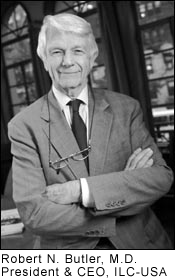
The Longevity Prescription - New Book by Robert Butler, MD
In The Longevity Prescription, The 8 Proven Keys to a Long, Healthy Life, ILC-CEO Dr. Robert Butler outlines eight essential facets of longevity: exercise, nutrition, mental vitality, sleep, relaxation, love and intimacy, community connections, and medical care. Based on proven discoveries, the strategies in each of these areas stretch the proceeds of the "threedecade dividend" while delaying or eliminating chronic illness. In The Longevity Prescription, readers will learn:
All author royalties will go to the International Longevity Center-USA
- why honing a center of balance is essential to physical health
- how to watch out for food additives and their damaging effects
- why it's important to establish a bedtime routine
- how starting a second career in retirement can be key to self- contentment, and more
All author royalties will go to the International Longevity Center-USA
Tuesday, June 8, 2010
TIME GOES BY | REFLECTIONS: On Longevity
by Saul Friedman
This began as an essay on longevity, the advances the United States and much of the world have made in increasing life expectancy. Then I came across this piece from The New York Times of October 24, 1880. The story, entitled, Living Too Long, began:
But it’s not my aim to promote access to good health care, but to examine a strange phenomenon. The world has had great success since 1880 in achieving a longer, heathier life for people almost everywhere. Indeed, life expectancy in most of the world has grown by 10 years just since 1960. And yet, too many Americans, politicians and ordinary people seem to fear longevity, and some are questioning whether we’re living too long.
A woman I met years ago who was the subject of my column on the problems of older Americans, had just placed her husband, suffering from Parkinson’s disease, in a nursing home and she didn’t know how to pay for it and continue to keep up her own home and living standards. “Who knew I would live this long?” she said. She was only 70.
A few weeks ago, a reader told me quite candidly that people on Medicare or Social Security were selfish and should forgo these programs, “that will keep you alive for a few more years; better to use the money to send your grandchildren to college.”
That we on Medicare and Social Security’s are living too long and are a drain on the rest of society is not a new idea. Twenty five years ago, the Atlantic Monthly, with the help of an ugly caricature, depicted older Americans as “Greedy Geezers.”
And about that time, then Gov. Richard Lamm of Colorado told a meeting of lawyers that elderly people who are terminally ill “have a duty to die and get out of the way” rather than try to survive by artificial means. People who allowed themselves to die, he said, are like “leaves falling off a tree and forming humus for other plants to grow...Let the other society, our kids, build a reasonable life.” He figured it’s better to be humus than to watch your grandchildren grow up.
In 1996, as a former governor, Lamm was at it again calling for Medicare to be cut tenfold because it was spending too much prolonging lives. And he predicted tht, as the society ages, “we have to learn to run a nation of 50 Floridas.” As we shall see, that sour vision of the future has cropped up more recently.
But the criticism that Medicare spent too much money on the last years of the lives of beneficiaries, along with efforts by Newt Gingrich’s Republican Congress to privatize Medicare and cut its funding, prompted Medicare in 1995 to begin its hospice program.
Medicare paid fully to care for patients whose doctor attested that they had less than six months to live. Patients who volunteered to enter hospice had to agree that they could receive only palliative care – pain killers and bedside help - to make them comfortable. But they were denied curative treatment, including their own routine medicines, even if there was a chance it would prolong their lives.
But the hospice program gave lie to the notion that death is the answer to saving money. Fortunately, as medical advances such as chemotherapy, open heart surgery and more sophisticated diagnostic techniques like the CT-Scan and PET-Scan became available and common, it was no longer as easy as Lamm suggested to call patients terminally ill, or to predict how much longer they had to live.
Few doctors will tell a patient how long he or she has to live for the course of an illness is not predictable for everyone. Cancer patients today may survive into their eighties. And the severely disabled, like Stephen Hawking, may contribute handsomely to the living.
As a result, Medicare now recognizes that the six-month prediction of a doctor, which is still required, may be extended indefinitely under current Medicare rules. Indeed, some patients get well enough to opt out of hospice care. In addition, Medicare dropped its prohibition on curative care and now permits a cancer patient to continue chemotherapy while in hospice.
Nevertheless, Medicare hospice will take over the care of a patient and is there to provide care for the patient (and comfort for the family) at the end of life.
Thus, it has become obvious that there is nothing predictable about aging except that it will end. Everything else is a matter of luck, background, chance, environment, genes and perception. We are not as old as our parents were at our age. And likely they didn’t live to be our age.
You know the cliches: 40 is the new 30; 60 is the new 50; and so on. As the boomers came of age, AARP recognized the changes in the perception and the realities of aging when it lowered its membership eligibility age to 50. In short, longevity is to be celebrated rather than feared.
One of the first writers to call for a celebration of longevity was social historian, Theodore Roszak, who wrote the classic study of the Sixties and coined a new phrase, in The Making of A Counter Culture. In his 1998 book, America the Wise, he called on the nation to celebrate and welcome the wisdom of America’s booming population of older Americans.
Roszak’s 2001 update of America the Wise, entitled The Longevity Revolution, says of longevity, “It is inevitable. It is good.” His optimism is shared by the godfather of the study of aging, Dr. Robert N. Butler, a geriatrician and founder of the New York-based International Longevity Center, a think tank on issues facing older America.
Butler won a Pulitzer Prize for his 1975 book, Why Survive, a pioneering study of what it’s like to grow old in America. His was not an encouraging picture of “old age.” He became the first director of the National Institute on Aging, and has done more than any one to call attention to the potential and problems of longevity. And despite the longevity alarmists, much has changed for the better.
His latest book, in contrast to his first, celebrates the rewards and possibilities of aging in America. Entitled The Longevity Prescription, Butler, who is active in his eighties, begins with a chapter on “Embracing longevity.” He notes that in the beginning of the 19th Century, life expectancy was 35. “In round numbers we can anticipate living ten thousand days longer than our ancestors could a century ago.”
Butler established the first school of geriatric medicine at New York’s Mt. Sinai Hospital, and speaking as a doctor, Butler says,
His advice includes, how to maintain mental vitality; why you should nurture old and new relationships; and how to get effective medical care.
I have interviewed Butler, was a participant at his first Age boom Academy at his longevity center and I know that he and Roszak are ardent defenders of Social Security and Medicare and advocates for single-payer, universal health insurance. To these ends, the new version of Roszak’s book exposes the rich predators who see longevity as “the Gray Peril,” driving America into bankruptcy because of the increasing costs of Medicare and Social Security.
Chief among these attackers of entitlements is former Nixon Commerce Secretary Pete Peterson, a Wall Street billionaire who now runs the right-wing Concord Coalition, which would privatize Social Security and Medicare. Roszak wrote that Peterson, who published a dire warning about the growth of entitlements in The Atlantic in May,1996, believes that they are unsustainable, unprincipled and unfair.
But more striking, said Roszak, Peterson’s warning treated older Americans as “an alien species of obnoxious, geriatric layabouts thronging the sunny shores of Florida.” He too warned that we should be prepared to become a nation of Floridas.
Nevertheless, Peterson’s long crusade has found comfort in, of all places, the Obama administration. Under pressure from conservative Democrats as well as Republicans, Obama created a commission to deal with the rising deficit. And as expected, the deficit hawks are not singling out the cost of wars and the military, but entitlements, including Social Security, which is sustained by payroll taxes and adds nothing to the deficit. And contrary to too much misleading reporting, it remains financially sound for at least another 30 years.
Peterson, who made millions as a hedge fund manager and took advantage of tax breaks, “continues to lecture on the need to cut Social Security and Medicare for retirees who have a tiny fraction of his wealth,” said economist Dean Baker.
Because of the recession and high unemployment, the Social Security system will pay out more in benefits this year and next than it takes in payroll taxes, but that happened in the recession of 1981-2 and in 1983, Ronald Reagan approved a fix that saved Social Security for 75 years.
Thus Baker chastised the Wall Street Journal for saying the Social Security trust fund will show a deficit; the trust fund earns interest on the bonds it sells to the Treasury and will show a surplus of $100 billion this year.
But on the larger issue of entitlement spending, Princeton’s Uwe Reinhardt, the nation’s leading heath economist put the hysteria about the cost of entitlements in perspective. In a lecture for the Woodrow Wilson School in Washington, he noted that outlays for all Social Security programs, though not part of the budget, will remain flat at six percent of the Gross Domestic Product for the next 60 years, while Medicare spending will rise from the current 3.59 percent to 8.74 percent in 2050.
But not to worry, Reinhardt said. By 2050, even at an annual growth rate of 1.5 percent, the GDP per capita will grow from the current $40,0,000 to $78,200.
I don’t think that will happen unless the Republicans, who are calling for the partial privatization of Social Security, get another chance to govern. Then those of us who welcome our own longevity will have reason to be afraid, very afraid.
TIME GOES BY | REFLECTIONS: On Longevity
This began as an essay on longevity, the advances the United States and much of the world have made in increasing life expectancy. Then I came across this piece from The New York Times of October 24, 1880. The story, entitled, Living Too Long, began:
“Generally speaking, one of the last and least of our anxieties is that we may live too long. Throughout youth and maturity, the prospect of longevity is very apt to be pleasant, for the thing itself seems desirable – far more so in the distance than if at hand.”As usual, The Times came to no conclusion although the article made a strong case against growing too old without telling us how long is too long? In 1880, the life expectancy in the U.S. for white males was 40. Today it’s 78.2, somewhat less than Japan (82.6) and most of Europe, (in the 80s) all of which provide universal health care.
But it’s not my aim to promote access to good health care, but to examine a strange phenomenon. The world has had great success since 1880 in achieving a longer, heathier life for people almost everywhere. Indeed, life expectancy in most of the world has grown by 10 years just since 1960. And yet, too many Americans, politicians and ordinary people seem to fear longevity, and some are questioning whether we’re living too long.
A woman I met years ago who was the subject of my column on the problems of older Americans, had just placed her husband, suffering from Parkinson’s disease, in a nursing home and she didn’t know how to pay for it and continue to keep up her own home and living standards. “Who knew I would live this long?” she said. She was only 70.
A few weeks ago, a reader told me quite candidly that people on Medicare or Social Security were selfish and should forgo these programs, “that will keep you alive for a few more years; better to use the money to send your grandchildren to college.”
That we on Medicare and Social Security’s are living too long and are a drain on the rest of society is not a new idea. Twenty five years ago, the Atlantic Monthly, with the help of an ugly caricature, depicted older Americans as “Greedy Geezers.”
And about that time, then Gov. Richard Lamm of Colorado told a meeting of lawyers that elderly people who are terminally ill “have a duty to die and get out of the way” rather than try to survive by artificial means. People who allowed themselves to die, he said, are like “leaves falling off a tree and forming humus for other plants to grow...Let the other society, our kids, build a reasonable life.” He figured it’s better to be humus than to watch your grandchildren grow up.
In 1996, as a former governor, Lamm was at it again calling for Medicare to be cut tenfold because it was spending too much prolonging lives. And he predicted tht, as the society ages, “we have to learn to run a nation of 50 Floridas.” As we shall see, that sour vision of the future has cropped up more recently.
But the criticism that Medicare spent too much money on the last years of the lives of beneficiaries, along with efforts by Newt Gingrich’s Republican Congress to privatize Medicare and cut its funding, prompted Medicare in 1995 to begin its hospice program.
Medicare paid fully to care for patients whose doctor attested that they had less than six months to live. Patients who volunteered to enter hospice had to agree that they could receive only palliative care – pain killers and bedside help - to make them comfortable. But they were denied curative treatment, including their own routine medicines, even if there was a chance it would prolong their lives.
But the hospice program gave lie to the notion that death is the answer to saving money. Fortunately, as medical advances such as chemotherapy, open heart surgery and more sophisticated diagnostic techniques like the CT-Scan and PET-Scan became available and common, it was no longer as easy as Lamm suggested to call patients terminally ill, or to predict how much longer they had to live.
Few doctors will tell a patient how long he or she has to live for the course of an illness is not predictable for everyone. Cancer patients today may survive into their eighties. And the severely disabled, like Stephen Hawking, may contribute handsomely to the living.
As a result, Medicare now recognizes that the six-month prediction of a doctor, which is still required, may be extended indefinitely under current Medicare rules. Indeed, some patients get well enough to opt out of hospice care. In addition, Medicare dropped its prohibition on curative care and now permits a cancer patient to continue chemotherapy while in hospice.
Nevertheless, Medicare hospice will take over the care of a patient and is there to provide care for the patient (and comfort for the family) at the end of life.
Thus, it has become obvious that there is nothing predictable about aging except that it will end. Everything else is a matter of luck, background, chance, environment, genes and perception. We are not as old as our parents were at our age. And likely they didn’t live to be our age.
You know the cliches: 40 is the new 30; 60 is the new 50; and so on. As the boomers came of age, AARP recognized the changes in the perception and the realities of aging when it lowered its membership eligibility age to 50. In short, longevity is to be celebrated rather than feared.
One of the first writers to call for a celebration of longevity was social historian, Theodore Roszak, who wrote the classic study of the Sixties and coined a new phrase, in The Making of A Counter Culture. In his 1998 book, America the Wise, he called on the nation to celebrate and welcome the wisdom of America’s booming population of older Americans.
“The future belongs to maturity,” he wrote. “Never before has an older generation (more than 80 million Americans in their sixties, seventies, eighties and even nineties) been so conversant with so many divergent ideas and dissenting values.”His book was published before the full force of the digital explosion, but the older generation, the aging boomers and even those who may be called elderly, are not lagging behind younger Americans in their skills with computers and accompanying gadgets. Indeed, the geniuses at Apple, Google, IBM, Microsoft and Amazon are beyond their boomer years.
Roszak’s 2001 update of America the Wise, entitled The Longevity Revolution, says of longevity, “It is inevitable. It is good.” His optimism is shared by the godfather of the study of aging, Dr. Robert N. Butler, a geriatrician and founder of the New York-based International Longevity Center, a think tank on issues facing older America.
Butler won a Pulitzer Prize for his 1975 book, Why Survive, a pioneering study of what it’s like to grow old in America. His was not an encouraging picture of “old age.” He became the first director of the National Institute on Aging, and has done more than any one to call attention to the potential and problems of longevity. And despite the longevity alarmists, much has changed for the better.
His latest book, in contrast to his first, celebrates the rewards and possibilities of aging in America. Entitled The Longevity Prescription, Butler, who is active in his eighties, begins with a chapter on “Embracing longevity.” He notes that in the beginning of the 19th Century, life expectancy was 35. “In round numbers we can anticipate living ten thousand days longer than our ancestors could a century ago.”
Butler established the first school of geriatric medicine at New York’s Mt. Sinai Hospital, and speaking as a doctor, Butler says,
“The average American does not need to resign himself or herself to spending these added decades descending slowly and unhappily into disease and disability...You are not your parents’ genes.”And he proceeds to dispel some of the myths of aging and he prescribes some reasonable things all of us can do to prevent illness and remain active and mentally alert. “No matter what your age, there are ways to enhance your longevity.” They seem as obvious as his admonition to quit smoking (Butler was a smoker), but they are too often overlooked.
His advice includes, how to maintain mental vitality; why you should nurture old and new relationships; and how to get effective medical care.
I have interviewed Butler, was a participant at his first Age boom Academy at his longevity center and I know that he and Roszak are ardent defenders of Social Security and Medicare and advocates for single-payer, universal health insurance. To these ends, the new version of Roszak’s book exposes the rich predators who see longevity as “the Gray Peril,” driving America into bankruptcy because of the increasing costs of Medicare and Social Security.
Chief among these attackers of entitlements is former Nixon Commerce Secretary Pete Peterson, a Wall Street billionaire who now runs the right-wing Concord Coalition, which would privatize Social Security and Medicare. Roszak wrote that Peterson, who published a dire warning about the growth of entitlements in The Atlantic in May,1996, believes that they are unsustainable, unprincipled and unfair.
But more striking, said Roszak, Peterson’s warning treated older Americans as “an alien species of obnoxious, geriatric layabouts thronging the sunny shores of Florida.” He too warned that we should be prepared to become a nation of Floridas.
Nevertheless, Peterson’s long crusade has found comfort in, of all places, the Obama administration. Under pressure from conservative Democrats as well as Republicans, Obama created a commission to deal with the rising deficit. And as expected, the deficit hawks are not singling out the cost of wars and the military, but entitlements, including Social Security, which is sustained by payroll taxes and adds nothing to the deficit. And contrary to too much misleading reporting, it remains financially sound for at least another 30 years.
Peterson, who made millions as a hedge fund manager and took advantage of tax breaks, “continues to lecture on the need to cut Social Security and Medicare for retirees who have a tiny fraction of his wealth,” said economist Dean Baker.
Because of the recession and high unemployment, the Social Security system will pay out more in benefits this year and next than it takes in payroll taxes, but that happened in the recession of 1981-2 and in 1983, Ronald Reagan approved a fix that saved Social Security for 75 years.
Thus Baker chastised the Wall Street Journal for saying the Social Security trust fund will show a deficit; the trust fund earns interest on the bonds it sells to the Treasury and will show a surplus of $100 billion this year.
But on the larger issue of entitlement spending, Princeton’s Uwe Reinhardt, the nation’s leading heath economist put the hysteria about the cost of entitlements in perspective. In a lecture for the Woodrow Wilson School in Washington, he noted that outlays for all Social Security programs, though not part of the budget, will remain flat at six percent of the Gross Domestic Product for the next 60 years, while Medicare spending will rise from the current 3.59 percent to 8.74 percent in 2050.
But not to worry, Reinhardt said. By 2050, even at an annual growth rate of 1.5 percent, the GDP per capita will grow from the current $40,0,000 to $78,200.
“Why should I worry about who will be running the world in 2050,” said Reinhardt, “when they will have so much real GDP to play with.”Finally, Pete Peterson and his Wall Street allies are smart enough to know, for example, that Social Security is not a budget problem. So why are they attacking it? For the same reason George W. Bush sought to turn the insurance and pension program into millions of 401(k)s: think of how Wall Street will celebrate if the brokers and bankers can get their hands on the bonds in the trust fund, worth $2.5 trillion.
I don’t think that will happen unless the Republicans, who are calling for the partial privatization of Social Security, get another chance to govern. Then those of us who welcome our own longevity will have reason to be afraid, very afraid.
TIME GOES BY | REFLECTIONS: On Longevity
Subscribe to:
Posts (Atom)


![Reblog this post [with Zemanta]](http://img.zemanta.com/reblog_b.png?x-id=7e7dd332-a2a2-4758-aa76-5a442e9e1c9c)